
The Shop Phone Should Not Own Dinner
AI voice reception is only the first ear. Field service needs work memory from phone to jobsite, so contractors can finally turn off the after-hours tether.
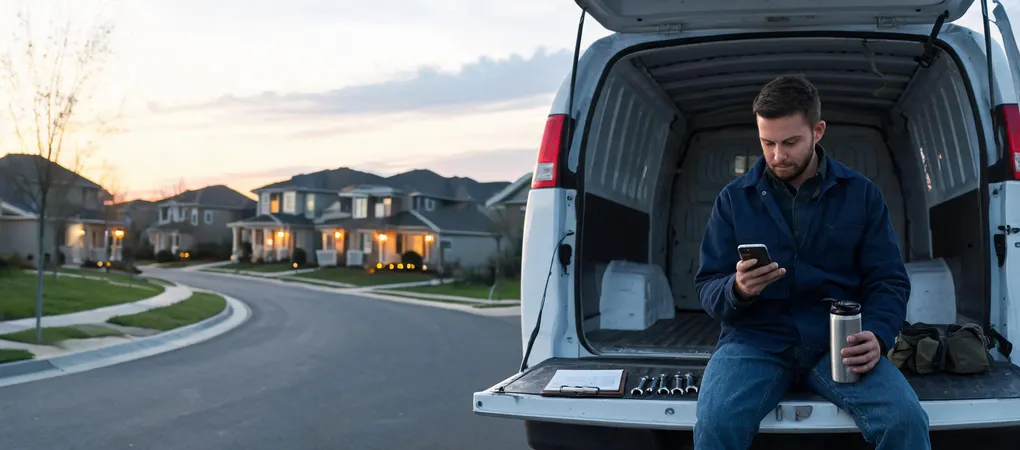
A fork in one hand, the company phone buzzing beside the dinner plate. Those two objects should not have to coexist, yet every home service owner knows the little ceremony: glance down, apologize with your eyes, decide whether the evening belongs to your family or the shop.
The weekend version is less polite. You are at a hardware store, a ball field, a job site, a funeral reception, and the phone still behaves like it owns equity.
The new AI receptionist headline is really about time
A FinancialContent headline this week announced an AI voice receptionist system for home service contractors. That is timely, because the trades are reaching a point where owners are no longer asking whether AI can talk. They are asking whether it can give them their evenings back without making the business feel colder.
Good question. The wrong answer is another dashboard, another queue, another place to check after the kids go to sleep. Very generous of technology to create more places for you to be behind.
The phone owns your evening because the business has no memory unless you personally hold it.
This problem has a name: the management tether. It is not simply that the phone rings. It is that each conversation carries details only you are trusted to catch: tone, urgency, the weird noise the customer described, the part that was changed last winter, the promise your tech made at the door.
That is why the burden feels personal. You are not holding a phone. You are holding context.
Always available is not a growth strategy. It is a tax on being awake.
Home service owners tend to normalize this because everyone around them does it too. HVAC is a huge, fragmented field: industry estimates put the U.S. HVAC market around $159 billion, with roughly 120,000 contractor businesses and hundreds of thousands of technicians. Fragmented industries run on phones, vans, notebooks, memory, and mild sleep debt.
But the hidden cost is not an abstract spreadsheet line. It is the dinner that turns into dispatch. The Sunday afternoon that becomes a mental triage room. The diagnosis you paid for twice because the work order was vague. The customer your tech can’t quite remember, even though everyone did their best.
When was the last time you ate dinner without the shop phone on the table?
Not silent on vibrate. Not face down like a tiny hostage negotiator. Actually off, because the business could listen, summarize, and hand you the context later.
This is where AI voice reception matters. Not because it is a novelty. Because a voice agent can take the routine after-hours conversation, capture the customer’s words, organize the facts, and give the owner a summary instead of a ringing obligation.
Telalive is built around that simple relief: customer phone conversations become searchable customer conversation memory. The point is not to make owners stare at more transcripts. The point is to let them stop being the only living bridge between the customer’s words and tomorrow’s work.
The office phone is only the first ear
But stopping at the front desk would be a small view of what is happening in AI. The bigger shift is that AI needs real-world input. Cameras gave AI eyes in factories, warehouses, and roads. Field service still lacks ears.
The most important facts in HVAC do not live neatly in a form. They happen in spoken fragments: on the roof, in the crawlspace, beside the condenser, at the customer’s door. The tech says the compressor sounds rough under load. The homeowner says the back bedroom never cools after 4 p.m. The senior tech mutters the pattern that only thirty years of summers teaches.
- The old system: reality happens in the field, then someone re-types a thin version later.
- The better system: spoken work becomes structured memory at the moment it happens.
- The real category: not a microphone, but the Field Voice Data Layer for work memory.
That is the thesis behind Hearit.ai HA-MIC01. It is the hands-free field ear: a wearable AI microphone that captures work-only field facts with consent and transparency, then turns them into service reports, work orders, and searchable Frontline Work Memory.
This is not about keeping tabs on workers. Technician dignity matters. The useful model is worker-controlled, transparent, and tied to the job, because the technician is not the problem to be monitored; the technician is the sensor that understands reality before any robot does.
Physical AI will ride with people first
There is a popular picture of Physical AI where a robot eventually climbs out of a van and fixes the unit. Fine. Maybe one day. For now, the first Physical AI in the skilled trades rides with the human worker.
The technician becomes the interface. Their voice, the customer’s voice, the equipment’s symptoms, and the repair context become the real-world input layer that back-office software has always needed but could not hear.
ServiceTitan, Housecall Pro, Jobber, Dynamics, and similar systems own important workflow. They schedule, route, invoice, and organize. But they still depend on humans to type the field reality in after a long day, usually during the 11 minutes that evaporated between the wrench and the keyboard.
There is an engineering reason this matters. Original field input is the source signal. A summary is derived from it. Reconstruction can get cheaper, but it cannot recreate a model number nobody spoke, a symptom phrase nobody captured, or a safety concern that died in a shift handoff.
Specification beats code: AI can reason only over the reality it was allowed to hear.
That is why the new voice receptionist wave is important, but incomplete. Telalive can give the shop an ear for the customer conversation. HA-MIC01 gives the field an ear for the work itself. Together, they point toward Enterprise Memory that starts outside the office, where the facts are born.
The owner should not have to be the permanent buffer between those worlds. Neither should the dispatcher. Neither should the senior tech whose pattern recognition walks out at retirement because nobody captured how he talked through a strange failure.
The relief is the product
The best AI phone agent for a contractor is not the one that sounds most impressive in a demo. It is the one that lets the owner trust the night again. It answers, asks the basic questions, records the customer’s wording as work memory, and gives a clean summary when the owner is ready to look.
That changes the feeling of the business. The phone can still exist. The work can still move. But the owner no longer has to keep one ear open during every meal, every weekend, every small human moment that should not require a dispatch policy.
AI in field service will not be defined by who chats the most fluently. It will be defined by who hears reality with enough respect to make work remember itself.
The first Physical AI in the trades will not look like a robot taking a ladder from a van. It will look like a contractor putting the phone face down at dinner, because the business finally has ears of its own.
From AI phone agents to custom hardware — we’ve got you covered.