
Before/After Photos Need the Same Spot
Plumbing repair proof depends on numbered issues, same-angle photos, and clear limits: cameras support records, but leak detection stays human on every job.
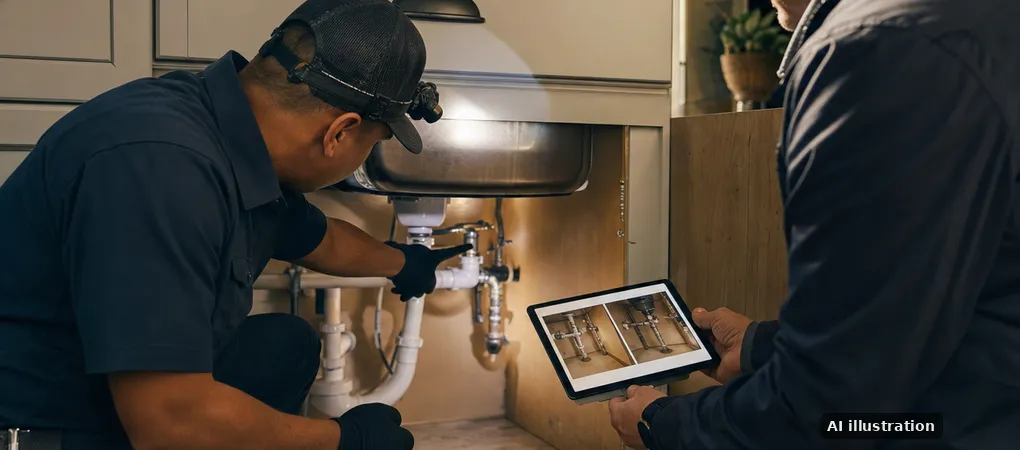
Everyone says the before-and-after photo proves the plumbing repair. The real problem is that many photos only prove somebody was near a pipe with a camera.
You know the job: a routine under-sink leak, swollen cabinet base, customer pointing at a towel, technician checking the trap, supply stops, disposal flange, dishwasher hose, and the wall penetration. The expensive part is not the photo. It is the argument later about whether the after photo shows the same problem location.
The myth: more photos fix the record
More photos often create more sorting. A service manager opens the job and sees ten close-ups of chrome, PVC, shadow, and wet wood. Very cinematic. Not very helpful.
Three things decide whether before-and-after evidence actually works:
- Issue numbering: The observation, quote, repair, and completion check need the same label. Issue 1 cannot become “sink leak” in the quote and “repaired drain” in the final note.
- Same spot: The after image must show the same pipe, joint, cabinet corner, wall opening, or ceiling area as the before image.
- Same angle: A beautiful after photo from the opposite side is still a different record. It makes the manager reconstruct the job from clues.
The engineering trade-off: repeatability vs friction
For a product team building a wearable field device, the practical trade-off is not “better camera.” It is repeatable capture versus technician friction.
- Fixed wide view: Lower operator burden. But hands, cabinet doors, darkness, and wide-angle distortion can hide the exact fitting that matters.
- Detachable or aimable module: Better detail near the work. But it adds connector choices, mounting durability questions, loss risk, and one more action in a cramped cabinet.
- Workflow-guided issue capture: The tech marks “Issue 2, left supply stop compression nut” and returns to that label at completion. But this costs prompt design, field training, software mapping, and pilot validation.
What changes the answer? The mix of jobs. A remodel rough-in, a warranty leak, and a service visit under a vanity do not need the same hardware behavior.
Pick the last return visit caused by an unclear plumbing record.
Could the manager tell which fitting was observed, which repair was quoted, and whether the final check showed that same spot?
The better frame: numbered work memory
A good plumbing record reads like a chain. Issue 1: moisture at rear left cabinet floor near supply penetration. Issue 2: active drip at hot-side compression nut. Issue 3: old staining below disposal flange, no active drip observed during test.
The quote uses those labels. The completion check uses those labels. The next visit can search those labels instead of asking a tired technician to remember which shiny thing was photographed.
This is where field AI becomes less magical and more useful. HA-VEST01 is still in prototype iteration and pilot preparation; its design direction is to explore how permitted on-site voice and optional images can be linked to the job so technicians reconstruct less and reports can be prepared for professional review. That has to be validated in a pilot, not assumed from a spec sheet.
“A camera can document where a plumber looked. It cannot see inside a wall, pressure-test a line, or replace leak detection.”
Humans still decide. Moisture readings, isolation tests, access cuts, pressure checks, dye tests, and judgment remain the work. The record should carry context, not pretend to diagnose the house.
If you run a plumbing team, share one de-identified job where absent information caused a return visit, and mark the fields that were hardest to capture. The useful future is not more media. It is the same issue, in the same place, carried from first observation to final check.