
Before the Dashboard, the Jobsite Speaks
Field operations do not fail at the dashboard. They fail earlier, when jobsite truth is spoken aloud, half-heard, and never captured.
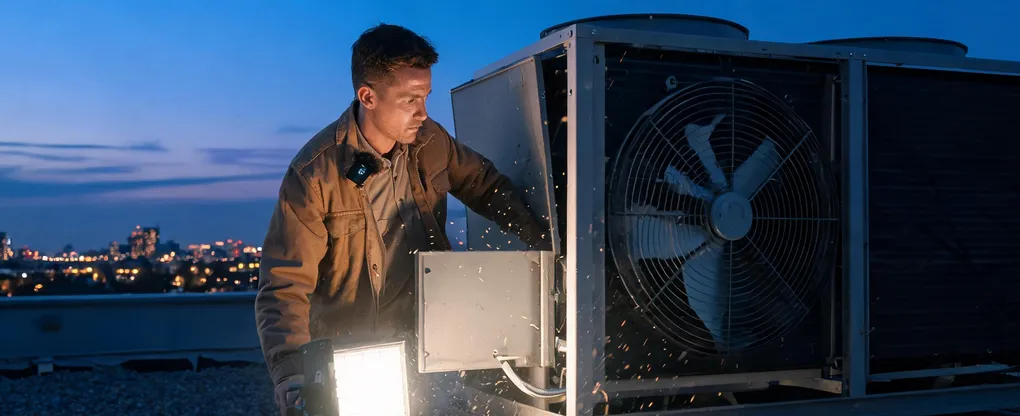
The Moment Before the Form
There is a small moment on almost every jobsite that decides more than it appears to decide.
A technician is standing near equipment that is louder than the office ever imagines. Another person is several steps away. A panel is open. A reading is taken, a condition is noticed, a workaround is chosen, a concern is spoken out loud. It may be about airflow, a failed component, access, water, power, a customer constraint, or simply the sequence of what should happen next.
Everyone on site understands it in that instant. The knowledge is present. It exists in the air between people.
Then the job moves on.
Later, something is typed into a form. A checkbox is touched. A photo is attached. A note is added if there is time, if the gloves are off, if the truck is not already needed elsewhere, if the technician believes the note will matter. The record becomes official only after the richest part of the work has already passed.
This is not a failure of discipline. It is not usually a failure of software adoption. It is how field work has always lived: in motion, in weather, in sound, in interruptions, in judgment made under pressure. The field produces knowledge continuously, but the business records it intermittently.
Owners and operators know this gap even if they do not name it. They feel it when a clean ticket does not explain a callback. They feel it when a manager has to reconstruct a job from fragments. They feel it when two good technicians remember the same site differently, not because either is careless, but because the work was never captured at the moment it was true.
For years, the office has tried to narrow this distance with better forms, better mobile apps, better dashboards. These tools have helped. But they begin after a quieter decision has already been made: what, from the jobsite, was allowed to become data in the first place.
The Dashboard Is Downstream
A dashboard has a certain authority. It is clean. It has columns, status colors, trend lines, exceptions. It gives management the feeling that the business has become visible.
But visibility is not the same as truth.
Every dashboard is downstream. It can sort only what was entered. It can summarize only what survived. It can alert only on signals that reached the system. If the original capture is thin, delayed, or distorted, the dashboard does not correct that weakness. It gives the weakness a better layout.
This is uncomfortable because many field businesses have invested heavily in the visible end of the system. Dispatch is visible. CRM is visible. Invoicing is visible. Reporting is visible. These are easier to evaluate because they live on screens. They can be demonstrated in a conference room. They can be compared feature by feature.
The jobsite does not behave like a conference room.
The most valuable information in a field business often appears in forms that software was not built to respect: a spoken observation, a hesitation, a technician explaining why the standard path will not work, a customer mentioning a symptom they forgot to report, a senior tech coaching a junior one through an unusual condition. These are not extras. They are the texture of the job.
In HVAC and adjacent trades, the scale is large enough that this texture matters. The United States HVAC market is commonly estimated at roughly $159 billion, with about 425,000 technicians working across the country. Behind those numbers are businesses trying to understand what actually happens when skilled people meet physical systems in imperfect environments.
If the capture layer is weak, the operation learns to manage around absence. It creates categories for what was convenient to record. It optimizes workflows around the part of the work that fits into the tool. Over time, the business may become very good at managing the shadow of the field rather than the field itself.
This is the quiet risk. Not that reports are wrong in an obvious way, but that they become internally consistent while missing the thing that would have changed the decision.
The Cost of Missing Truth
Weak capture rarely announces itself as a single dramatic loss. It accumulates.
A callback is coded as a technical issue when the real cause was an access constraint mentioned on site. A training need hides inside several completed jobs because the uncertainty was spoken only between technicians. A recurring equipment condition is seen by the field before it is seen by management, because the evidence remained in conversation. A customer experience problem appears as a schedule problem because the emotional context never entered the system.
When this happens, leaders do what responsible leaders do. They ask for more reporting. They refine the workflow. They add required fields. They introduce a new dashboard view. They tighten the process.
Sometimes this helps. Sometimes it only increases the distance between the work and its record.
Field crews are not against documentation. Most technicians understand, perhaps better than anyone, why the record matters. But there is a practical boundary. The worker who is thinking about diagnosis, safety, customer presence, parts, weather, schedule pressure, and the next job is being asked to become a clerk at the least clerical moment of the day.
The result is a kind of management theater that no one intended. The office sees more structured data. The field feels more administrative weight. The reports become cleaner. Yet the original loss remains close to the ground, where the work was spoken and not captured.
I have come to believe that many operational problems described as software problems are actually capture problems wearing software clothing. The system is not always failing at analysis. It is often starving before analysis begins.
At GMIC AI, this conviction did not come from a whiteboard. It came from years spent building hardware that has to survive real sites and actually hear them. Once you spend enough time with the physical conditions of field work, the category begins to look different. The question stops being only what should the workflow be. It becomes what did the system manage to hear.
Hearing Is a Physical Problem
There is a reason this frontier has been overlooked. Capture sounds simple when described from the office.
Just record the job. Just capture the voice. Just use a phone. Just add AI.
But field voice is not office voice. It is not a podcast. It is not a meeting room with soft walls and people facing a device. A jobsite has compressor noise, wind, traffic, mechanical vibration, distance, masks, ladders, attics, roofs, basements, and voices turned away from the microphone. The worker is not performing for the machine. The machine must adapt to the worker.
Consumer microphones were built for a different world. They expect proximity, relative quiet, predictable orientation. They were designed around convenience, not around the physics of a mechanical room or the edge of a roof. Software can clean some things. It cannot invent what the sensor never captured.
This is why the capture layer is not merely an app feature. It is hardware, acoustics, edge conditions, ergonomics, and trust. It is the unglamorous layer that determines whether the first version of the truth is rich or already damaged.
The industry has grown comfortable discussing artificial intelligence as if intelligence begins in the cloud. But in field operations, intelligence begins at the microphone, at the body, at the point where human knowledge becomes a signal. If that point is weak, everything after it becomes compensatory.
This does not mean every spoken word should be stored forever, or that surveillance is the answer. Serious operators understand the difference between visibility and intrusion. The goal is not to listen to people as subjects. The goal is to preserve the work as work: the decisions, conditions, constraints, and observations that the business already depends on but often fails to keep.
There is an old habit in operations of treating the field as something to be translated into software. The next habit may be more subtle: treating the field as the primary source, and designing the system with enough humility to receive it.
Owning the First Inch of Truth
The operators who win the next decade of field service will not necessarily be the ones with the prettiest dashboards. They will be the ones who understand where their records begin.
They will ask different questions. Not only whether the report is easy to read, but whether the job was captured while it was alive. Not only whether technicians completed the workflow, but whether the workflow received the judgment technicians were already producing. Not only whether management can see the data, but whether the data began close enough to the work to deserve management’s confidence.
This shift is quiet, but it is not small.
When a business owns its capture layer, it changes the character of everything downstream. Dispatch learns from reality rather than assumptions. Training reflects actual field uncertainty rather than after-the-fact summaries. Quality control becomes less dependent on memory. Customer communication carries more context. The dashboard becomes less theatrical because the source is stronger.
At GMIC AI, our work on jobsite hearing has made me less impressed by polished software surfaces and more interested in the first inch of truth. That first inch is where most systems are either born honest or born compromised.
Field businesses have always known that the real work happens on site. The software industry has often behaved as if the real record begins afterward.
It may be time to reverse that order. Before the ticket, before the dashboard, before the workflow, the jobsite speaks. The future of field management may belong to those who learn to hear it first.