
What Should a Crawlspace AI Wear?
AI agents for small business need field facts. Compare phone, voice wearable, AI vest, and instruments for crawlspace work documentation.
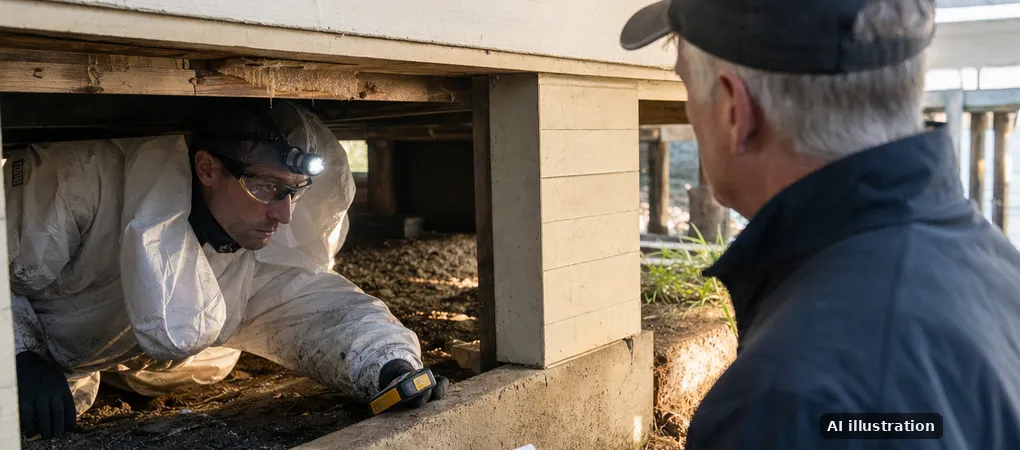
An AI agent in the office and a tech belly-crawling under a damp floor should not belong in the same sentence. But that is exactly where small-business AI is heading in 2026.
The current wave of articles about AI agents for small businesses, including the recent Bitcoin Foundation headline, is useful because it moves the discussion from novelty to operations. The weak point is that most agent talk still assumes the facts are already digital.
The agent can reason only after the work has been made readable.
In crawlspace inspection and repair, that is the hard part. The valuable facts are spoken while the tech is on elbows, pointing a light at wet insulation, explaining access limits, naming the beam, noticing the smell, and deciding what needs a second look.
So the useful question is not, “Which AI agent should we buy?” It is, “What should the field worker carry so the agent has reality to work from?”
The decision framework: match the tool to reconstruction cost
Every documentation method has three costs: motion, cleaning, and review. Motion is what the tech must stop doing to document. Cleaning is what gets mud, sweat, fiberglass, and crawlspace dust off the gear. Review is the time spent turning scattered evidence into a report someone can trust.
The right wearable is the one that matches the cost of reconstruction.
1. Phone in hand
A phone is enough when the job is visible, clean enough to handle a screen, and the report needs a few photos plus a short note. A simple vapor barrier check near the access opening may not justify anything more.
- When it is enough: quick visual proof, simple before-and-after photos, homeowner-facing pictures, short notes after the tech exits the space.
- What it misses: the spoken reasoning while the tech is still looking at the problem, the exact path through the crawlspace, and the detail that seems obvious until the truck leaves.
- Cost in motion, cleaning, review: high motion cost in dirty spaces, frequent glove changes or screen taps, wipe-down after use, and review time spent matching photos to report fields.
The phone is not bad. It is just a poor tool when the worker needs both hands and the evidence is happening continuously.
2. Clip-on or head-worn voice device
A clip-on or head-worn device makes sense when voice is the primary record. The tech can describe “left of the main beam,” “standing water near the rear pier,” or “access blocked by stored material” without stopping to type.
- When it is enough: long walkthroughs, training notes, inspection narration, and jobs where the biggest gap is what the tech said but did not type later.
- What it misses: images, readings, object location, and the difference between a general comment and a report-ready finding.
- Cost in motion, cleaning, review: low motion cost once worn, but placement matters; cleaning means dust, sweat, and straps; review can become a long transcript unless the workflow marks what belongs in the report.
Pick the last crawlspace return visit. What did the first tech observe in their own words?
Now check the work order. The gap between the two is where your AI agent will either become useful or start guessing.
3. Wearable AI vest
A vest is for a different class of work: dirty, multi-zone, hands-free, and easy to misremember. It is not a fashion statement. It is a work kit for carrying permitted voice, optional images, power, and modules without asking the tech to juggle tools like a circus act designed by procurement.
This is where Hearit.ai HA-MIC01 fits as the hands-free field ear, and where HA-VEST01 is being designed for crawlspace, HVAC, and plumbing pilots: linking permitted on-site voice and optional images to the job so teams reconstruct less and prepare reports for professional review.
- When it is enough: complex inspections, dirty environments, jobs with several findings, and work where the technician’s explanation is as important as the photo.
- What it misses: it does not replace instruments, professional judgment, consent practices, or report review. It is not worth it for clean, short, low-detail jobs.
- Cost in motion, cleaning, review: lower motion cost during the inspection, but higher setup discipline; cleaning and garment handling must be designed into the process; review still needs a human eye because diagnosis belongs to professionals.
The vest is also not worth trialing if the team is not ready to define work-only use, visible consent, and technician control. If it feels like surveillance, adoption will be brittle. If it feels like the tech’s own memory aid, the conversation changes.
4. Dedicated instruments
Moisture meters, hygrometers, thermal cameras, and other dedicated tools remain essential. They create the objective readings that voice alone cannot invent, and they keep diagnosis grounded in evidence.
- When they are enough: defined measurements, code or compliance checks, repeat readings, and cases where the decision depends on a specific physical value.
- What they miss: why the reading was taken, what was inaccessible, what the customer was told, and what the tech wants the next person to know.
- Cost in motion, cleaning, review: tool switching, probe cleaning, device storage, image export, and manual explanation after the fact.
Why this matters for AI agents
Back-office SaaS already owns workflow. AI agents will increasingly own reasoning steps: summarizing, preparing follow-up tasks, checking completeness, and helping teams search old work. But the most valuable crawlspace data is still born in a place software cannot see.
That data is perishable. The tech remembers it clearly for a while. Then the next job, the next attic, the next wet corner of a foundation all start blending together.
The economic point is simple: instruments depreciate, but work memory compounds. A reading solves today’s question. A searchable spoken record helps the next visit, the next estimate, the next handoff, and the younger tech learning from a veteran’s pattern recognition before it walks out at retirement.
If you are deciding what to trial, do not start with the fanciest device. Start with the report field your team struggles to fill accurately after a hard crawlspace job.
Then compare the tools honestly. A phone may be enough. A clip-on voice device may solve the main gap. A vest may be useful when the work is dirty, continuous, and hard to reconstruct. Instruments remain non-negotiable for readings.
For a pilot conversation, share a de-identified work order or report and mark the fields that are hardest to capture in the moment. The future of small-business AI will not be decided only by better agents. It will be decided by whether the work arrives with enough reality attached.