
The Field Service Report Needs an Ear
AI service reports only work when the field has memory. Why customer conversations and jobsite voice are becoming the next input layer for HVAC teams today.
The most expensive sentence in a service business is: “I think that was the unit with the noisy inducer.”
You know the moment. A customer calls back about last week’s visit, the dispatcher opens the work order, and the note is technically there but practically useless: checked system, discussed options, follow up.
Now the shop has to reconstruct reality. Which unit? What did the customer say in the driveway? Did the tech mention the rusted pan, the odd vibration, the tenant’s schedule, the dog in the side yard, the panel that needs two hands to open?
This is where AI service reports become interesting. Salesforce recently published a piece on AI service report insights for growing businesses, and the timing is right because every operator is asking the same question: what can AI tell me about my service work that my current system cannot?
My answer is simple: AI can only reason from what the business remembers.
And most service businesses do not have a reporting problem first. They have a memory problem.
The report is downstream from memory
A service report is treated like an administrative artifact. Something the tech fills out because the job needs to close, the invoice needs to move, and the office needs enough detail to keep the day from falling apart.
But the report is also the raw material for every AI insight that comes after it. Bad inputs become polished guesses. Thin notes become thin intelligence.
“The winning service company will not be the one with the most dashboards. It will be the one with the clearest memory of the work.”
Look at HVAC. The U.S. market is roughly $159 billion, with about 120,000 contractors and around 425,000 technicians. It is large enough to matter and fragmented enough that memory breaks every day in ordinary ways.
A senior tech remembers a pattern because he has seen it for 30 years. A newer tech writes “system running at departure” because the next job is already waiting. The office gets a sentence where the business needed the whole scene.
The economics are hiding in the reconstruction
This is not abstract. The cost shows up as reconstruction labor.
The dispatcher asks the tech to remember. The tech scrolls photos. The service manager reads between lines. Someone calls the customer to clarify what should have been captured in the moment.
- Before: “Customer says issue is back. Need follow-up.”
- After: “Customer said upstairs warms after 3 p.m.; tech noted weak airflow at bedroom register, suspected duct restriction, customer prefers morning appointment, attic access through hallway closet.”
- Before: The next tech starts from the invoice.
- After: The next tech starts from the conversation.
That difference changes the day. Not because AI wrote a prettier report, but because the company preserved the field reality that the report was supposed to represent.
The Bureau of Labor Statistics lists HVACR mechanics and installers at a median pay of about $59,810 per year in 2024. Add truck time, dispatch time, manager time, and the cost of repeating diagnosis becomes very physical very quickly.
Pick the last return customer. Without checking the system, what did your tech say about that home, that unit, and that customer last visit?
Now check the work order. The gap between those two answers is where your company’s memory is leaking.
Conversations are the first untapped data source
Most businesses already bought software for workflow. ServiceTitan, Housecall Pro, Jobber, Dynamics, Salesforce, and others organize the back office, the schedule, the customer record, and the process.
But all of them depend on a human translating the real world into boxes. And the real world in field service is spoken before it is typed.
The customer explains the symptom in their own words. The apprentice asks why the pressure looks wrong. The senior tech says, almost casually, “This model does that when the coil has been wet too long.”
That sentence is training data. It is institutional memory. It is also usually gone by lunch.
This is why I think the next input layer for service businesses is voice. Not voice as a gimmick. Voice as the most natural interface for work that happens with hands full, gloves on, and the clock moving.
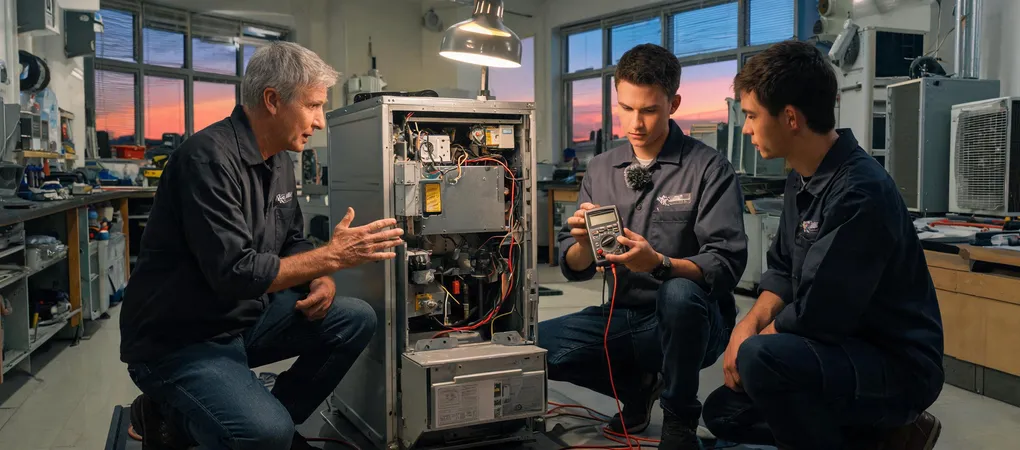
Telalive turns customer phone conversations into searchable customer memory. Hearit.ai HA-MIC01 extends that idea into the field, where the most important facts are often spoken on a roof, in a crawlspace, beside a compressor, or at the customer’s door.
AI has eyes. Field AI needs hearing.
The AI industry has spent years giving machines eyes. Cameras see shelves, roads, faces, parts, meters, defects, and motion.
But field service is not only visual. It is verbal, situational, and social. The truth of the job is often inside the explanation, the question, the hesitation, the side comment, the handoff.
“Robots need eyes. Field AI needs ears.”
I do not believe the first wave of Physical AI in the trades is a robot replacing the technician. It is AI riding with the technician, listening to the work, and turning the spoken job into memory the business can search and act on.
The technician becomes the sensor. Not in a surveillance sense. In a dignity-preserving sense: worker-controlled, work-only, transparent capture that reduces typing and protects expertise from disappearing at the end of a shift.
There is a human reason this matters. People do not remember work as a database. We remember the gist, the emotion, the unusual detail, and the last thing that went wrong.
After ten hours, the mind compresses. The report becomes a reconstruction, not a record of the moment. That is not laziness; it is cognition.
From service reports to Enterprise Memory
When every phone call and field conversation becomes structured memory, the service report changes shape. It stops being a thin closing document and becomes the visible surface of a deeper customer profile.
The next visit starts with what they said in their words. The office sees the detail behind the summary. The new tech inherits the senior tech’s pattern recognition instead of starting from a blank line.
- Customer memory: preferences, constraints, symptoms, and exact language from prior conversations.
- Equipment memory: recurring noises, observed conditions, parts discussed, and diagnosis history.
- Work memory: what was said at the unit, what was explained to the customer, and what should guide the next visit.
That is the category I care about: the Field Voice Data Layer. SaaS owns the workflow. AI owns the reasoning. But the field still needs an input layer that hears the reality those systems cannot see.
HA-MIC01 is the hands-free field ear for that layer. It captures the spoken work at the moment it happens and turns it into service reports, work orders, and searchable Frontline Work Memory.
Salesforce is right to point growing businesses toward AI service report insights. But the deeper question is upstream: what does the AI actually know?
If the business only remembers what someone had time to type, the AI will reason from fragments. If the business remembers the call, the handoff, the diagnosis, the customer’s words, and the field explanation, the AI begins to act like an institutional memory.
That is the shift. Not more software. More memory.
The next service report will not begin at the keyboard. It will begin where the work begins: with someone speaking truth into the jobsite air, and an AI ear finally there to remember it.
From AI phone agents to custom hardware — we’ve got you covered.