
From Five Samples to a Real Pilot: What to Measure
Turn five recorder samples into a pilot: test your own transcription, field conditions, transfer reliability, capture rate and supplier scope before launch.
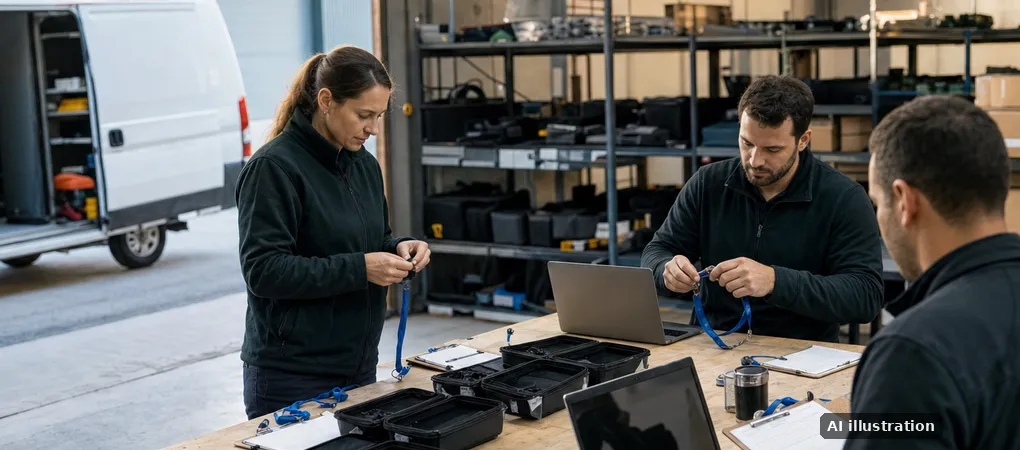
Five samples can create false confidence in less than one afternoon. They pair, they record, the transcript looks acceptable, and the team starts talking about rollout.
That is the common myth: samples tell you whether the recorder is good. They do not. Samples tell you whether the device can work on a desk, under attention, for a short test.
Measure the route, not the recorder.
The better frame is simple: turn samples into a measured path from sound, to file, to transfer, to your transcription, to the decision your app makes next. If that route works in the real setting, you have evidence. If it only works in a conference room, you have a demo.
For teams comparing supplier paths, it also helps to understand how a white-label recorder launch runs before treating a sample as a production answer. Logo and packaging are one level of decision; firmware behavior, endpoints, SDK integration, and pilot logging are the parts that make the result meaningful.
Myth: five samples are enough to choose hardware
They are enough to reject obvious problems. They are not enough to choose a deployment device for your own app and cloud.
Here are the three proofs.
Proof 1: your transcription pipeline changes the answer
A supplier’s sample recording can sound fine and still perform poorly once it passes through your speech-to-text model, speaker rules, file segmentation, diarization, summarization, or compliance workflow. The device is only one component in the capture system.
Test samples through the same route a pilot device will use. For GMIC platforms, audio can reach your software through your app over BLE, with the SDK handling pairing, recording control, file sync, device status, and related device operations. On Wi-Fi platforms such as MIC05 and MIC06, audio can also upload directly to your cloud endpoint or private server.
- Use your real models: Do not judge using only a generic transcription page or a supplier demo tool.
- Use your real file rules: Segment length, timestamps, device identity, and retry behavior affect downstream quality.
- Use your real app state: Pairing, reconnection, battery status, storage state, and firmware version should be visible where your support team will need them.
Proof 2: transfer failures are product failures
A good recording that never reaches your cloud is not a good capture event. Transfer behavior is where many sample tests are too polite: one phone, one office Wi-Fi network, one engineer watching every step.
A pilot should count failed transfers, delayed transfers, duplicate uploads, partial files, pairing failures, reconnection problems, and user actions that interrupt sync. The SDK or firmware should provide enough status to separate user behavior from device behavior from network behavior.
- BLE path: Confirm what happens when the phone moves away, the app is closed, the device reconnects, or sync resumes later.
- Wi-Fi path: Confirm endpoint authentication, retry rules, upload after power loss, and how failed uploads are reported.
- OTA path: Confirm whether firmware updates happen through your app or cloud and how build versions are tracked during the pilot.
Proof 3: the real environment is part of the product
A quiet sample test hides the hard parts: clothing rub, table vibration, pocket placement, distance from the speaker, background music, vehicle noise, wind, repeated handling, shift timing, and users who do not think like engineers.
For example, a team building a field note app should not only record a scripted meeting. It should record during the real work pattern: walking, stopping, speaking at odd angles, syncing later, and handing the device to someone who did not read the setup notes.
What the pilot should measure
A real pilot is not a larger sample order. It is a measurement plan with enough devices, users, locations, and days to expose repeatable behavior.
Start with three metrics. They are not the only ones, but they keep the decision honest.
- Capture rate: Of the moments that should have been recorded, how many produced usable audio in your system?
- Transfer failures: How many recordings failed, stalled, duplicated, arrived late, or required manual recovery?
- Audio quality: How often did the audio support your transcription and AI task without clipping, missing speech, heavy noise, or unusable speaker separation?
A pilot is useful only if failure is visible.
Before ordering pilot units, use a 30-minute scoping call to align on budget range, device path, firmware scope, endpoint behavior, and what logs are needed to make a decision.
What to agree with the supplier before the pilot
Most bad pilots fail before the first device ships. The team never defines what the device should do, what counts as a failure, or which changes are allowed during the test.
Agree on these items in writing before the pilot build is prepared.
- Device path: White label, platform customization / OEM, or full ODM. White label covers logo, packaging, manuals, and app branding. Platform customization covers firmware behavior, button logic, upload endpoint, and SDK integration without industrial or mechanical design change. Full ODM covers new ID/MD, tooling, PCB, audio, and battery work.
- Platform choice: MIC01 is a push-to-talk Bluetooth 5.3 platform. MIC05 adds Wi-Fi, Bluetooth 5.3, hardware noise reduction, NFC, encrypted firmware, and more onboard memory. MIC06 adds Wi-Fi, Bluetooth 5.3, slide-touch control, gyroscope, NFC, encrypted firmware, and private-server deployment.
- Recording behavior: Push-to-talk, scheduled recording, pause rules, indicators, file naming, timestamps, and what happens at low battery or full storage.
- Data route: BLE through your app, Wi-Fi upload to your cloud endpoint, or private-server route where supported.
- SDK scope: Pairing and reconnection, recording control, file transfer and sync with retry, battery and storage status, firmware version, OTA updates, device identity, endpoint authentication, documentation, and developer support.
- Test setting: Where devices will be worn or placed, who uses them, what background noise is expected, and how consent and user notices are handled.
- Success and stop criteria: The capture rate, transfer failure pattern, and audio quality level that justify moving forward, changing scope, or stopping.
- Change control: Which firmware, app, model, and prompt versions stay fixed during the measurement window so results can be compared.
- Production assumption: Expected path after pilot, approximate order level, certification planning, packaging, and manufacturing ramp assumptions.
Where GMIC fits, and where it does not
GMIC AI designs and manufactures custom AI voice hardware for product teams that keep their own app, speech-to-text, AI, and data. Engineering and production are in Shenzhen, the commercial team is in California, and manufacturing is carried out by GainStrong, part of the same group.
The fit is strongest when you need an existing BLE or Wi-Fi voice platform adapted to your software, with firmware behavior, SDK/API integration, audio tuning, certification planning, and production considered together.
- White label: Around 500 units, when the platform behavior already matches the use case closely.
- Platform customization / OEM: Around 500 units, when firmware behavior, button logic, endpoint, and SDK integration matter but the physical design can stay the same.
- Full ODM: Around 2,000 units, when you need new industrial design, mechanical design, tooling, PCB, audio, or battery architecture.
- Proof-of-concept: Runs on existing platforms are evaluated case by case.
GMIC is not the right fit if you only need to buy a retail recorder, if you expect GMIC to run your AI cloud or own your data layer, or if your required launch quantity is far below a practical hardware program. It is also not a small platform customization if you need a display, camera, or cellular connectivity; those can be added, but they change the architecture and belong in a full ODM program.
The timing should also be treated as part of the decision. The simplest proof of concept can be delivered in as little as 2 weeks with an expedite fee. A platform-based prototype or MVP typically takes 25–45 working days after scope and specifications are agreed, small-batch production takes about 40 working days after MVP validation, and volume ramp reaches steady delivery 20–45 working days after the small batch. Component supply is the main variable.
If the commercial plan starts with a branded device, review how a white-label recorder launch runs before the pilot, not after. That keeps packaging, app branding, manuals, firmware behavior, and production assumptions from becoming late surprises.
The practical takeaway
Five samples should not answer “Is this a good recorder?” They should answer a sharper question: can this hardware, firmware, transfer route, and SDK produce usable audio inside your product under real conditions?
Measure capture rate, transfer failures, and audio quality through your own pipeline. Then the pilot becomes a decision tool, not a box of promising gadgets.