
The Guardrail You Can Touch
AI agents need more than cloud rules. In HVAC field work, the physical switch, light, and upload boundary decide whether work memory is trusted.
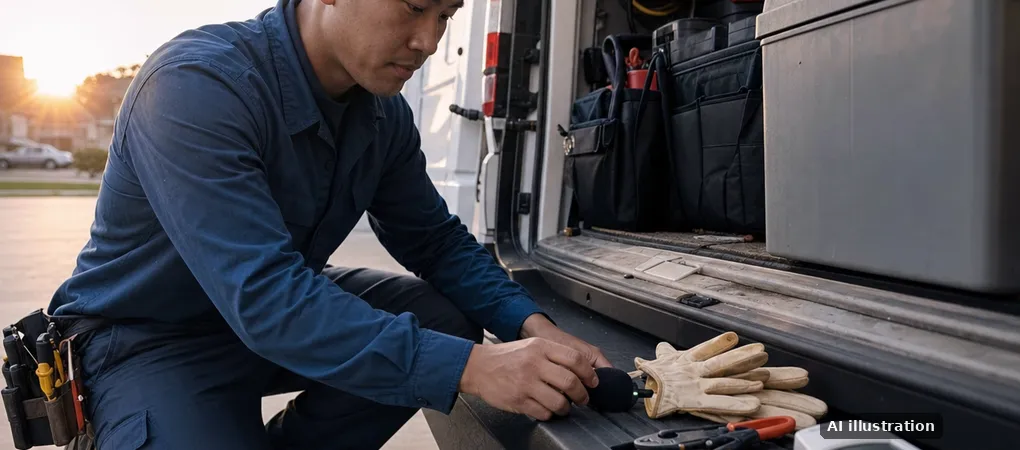
Which version of the job should your AI trust: the one designed in your workflow, or the one that came back from the house?
That is the Version Gap Review. It is a simple framework for AI hardware teams building for HVAC, plumbing, electrical, and inspection work.
- Designed Version: what the product spec assumes will happen.
- Shipped Version: what the technician can actually use with gloves, dust, heat, sweat, and a homeowner waiting.
- Returned Version: what the office receives later as a report, work order, or job memory.
The current AI-agent conversation is full of warnings about automation loops running too far. That is useful. Small businesses do need approval steps, spending limits, audit trails, and stop buttons.
But in field service, the first guardrail is not always a cloud rule. Sometimes it is a switch you can feel.
Field note: the AI agent problem starts before the agent
An HVAC tech finishes a long service visit. The unit was checked. The homeowner was told why the part matters. A sound from the blower was explained. A decision was made.
Back at the office, the written note carries only part of that reality. Now an AI agent can draft, summarize, route, and prepare the next step. But it is working from a thin version of the job.
The durable rule: guardrails are weakest when the input is vague.
This is why the Field Voice Data Layer matters. SaaS can own the workflow. AI can own the reasoning. But the most perishable field facts still happen out loud, in the moment, with tools in hand.
Hearit.ai HA-MIC01 is designed for that input problem: hands-free, work-only voice context that can become service reports, work orders, and searchable frontline work memory with human review.
The ODM trade-off: touch control vs sealed enclosure
Here is the hardware decision product teams underestimate: how should a wearable voice device start, pause, and show state?
The designed version says, “make it simple.” The shipped version asks a harder question: can a technician trust it without looking at an app?
- Option 1: Software-only control. Clean enclosure. Fewer openings. Faster industrial design. The cost is field friction: wet hands, gloves, ladders, crawlspaces, and weak visible consent at the moment work begins.
- Option 2: Capacitive tap control. Smooth surface and easier sealing. The cost is tuning. Sweat, dust, sleeves, and accidental touches can create ambiguity, so firmware has to work harder.
- Option 3: Membrane push button plus status light. Better tactile feedback for gloved work. The cost is mechanical stack-up: gasket design, tact switch life, adhesive choice, assembly control, and more validation around ingress paths.
- Option 4: Mechanical slider or lockout. The clearest human intent. The cost is size, parts count, snag risk, sealing complexity, and more manufacturing steps.
There is no universal answer. A crawlspace inspection pilot will weight tactile certainty differently than an indoor maintenance workflow. A dusty attic changes the answer. So does a policy that requires the worker to visibly control work memory.
Pick the last return customer.
Without checking the system, what did your tech explain at the unit last visit? Now read the work order. The gap is the product requirement.
Field note: consent is also an industrial design problem
Consent-first design cannot live only in a settings page. In skilled trades, it has to survive motion, noise, cramped access, and habit.
A status light that is too small becomes decoration. A button that cannot be felt through gloves becomes theory. A sealed enclosure that hides state may pass a lab review and still fail the shop owner’s trust test.
- Worker control: the tech should understand when work memory is active.
- Work-only boundary: the product should be designed around the job, not private life.
- Visible state: the homeowner and the technician should not have to guess.
- Human review: AI can prepare the record; people still diagnose, decide, and approve.
This is where agent guardrails and ODM engineering meet. The cloud can stop an AI action after a threshold. The device can reduce confusion before bad context enters the system.
The timing is now because agents need field memory
AI agents are getting better at taking action inside software. That is the trend. But field-service businesses do not run only inside software.
They run in driveways, basements, mechanical rooms, roofs, and crawlspaces. The next advantage is not a smarter form. It is a better real-world input layer, tied to job context and bounded by dignity.
The technician becomes the sensor before any robot becomes the worker. Not because people are being replaced. Because the spoken record of skilled work is too valuable to vanish at the end of the day.
For a pilot, the cleanest starting point is not a demo. Share a de-identified work order or report and mark the fields hardest to capture. The gap between what the technician knew and what the system kept is where Physical AI begins.