
The HVAC Agent Needs a Brake
AI agents need brakes in HVAC. The real test is whether a tech’s spoken field context survives the hallway moment when notes usually break.
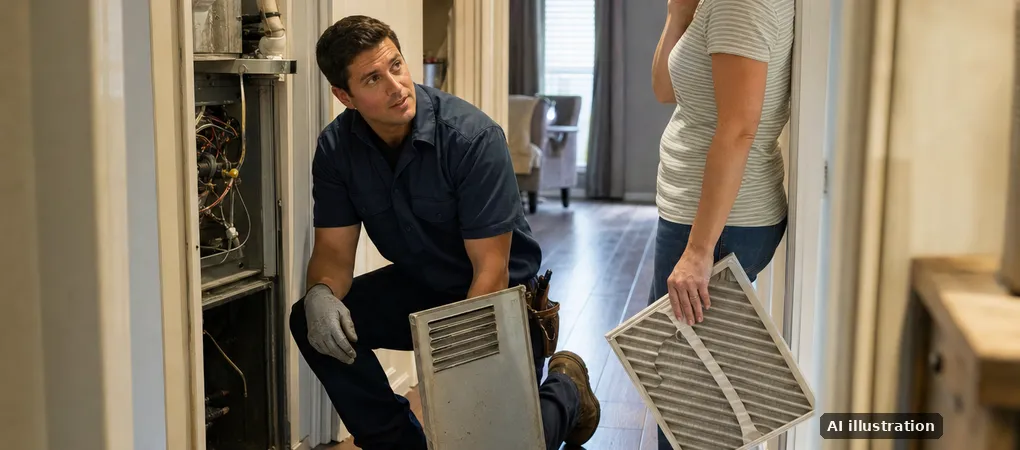
The access panel is balanced against your technician’s knee, one glove is on the low-voltage wires, the blower is loud, and the homeowner is asking whether the filter caused all this.
That is the moment the record breaks.
The AI guardrail problem is moving into the hallway closet
The current AI agent story is about guardrails. One bad automation loop sending 400,000 emails in three days makes the point cleanly: cheap automation can outrun judgment.
HVAC shops will not feel that first as a giant email problem. They will feel it when an agent prepares a follow-up, a parts note, a warranty summary, or a customer explanation from a work order that says, “checked system, advised customer.”
Illustrative example: the closet air handler
In this common hallway-closet job, the technician may say three important things while working: the return is restricted, the coil is beginning to ice, and the homeowner mentioned a bedroom that never cools after sunset.
Only one of those may reach the final note. Sometimes none of them does, because the tablet is closed, the gloves are dirty, the customer is talking, and the next job is already waiting.
- Lost field fact: what was observed before the system was disturbed.
- Lost customer language: how the homeowner described comfort, noise, smell, or timing.
- Lost decision path: why the technician chose to clean, monitor, quote, or escalate.
This matters most when there is a return visit, a handoff to a senior tech, a quoted repair, a warranty question, or a comfort complaint that depends on sequence. It matters less on clean filter changes, simple tune-ups, or shops where the technician finishes the note before leaving the driveway.
Pick the last return customer with a comfort complaint.
Without checking the system, what did your tech say the homeowner described last visit? Now check the work order. The gap is where the next AI agent will guess.
Use the Field Brake
A useful HVAC guardrail is not only a policy screen. It is a brake between field reality and automated action.
Call it the Field Brake: Permission, Proximity, Pause.
- Permission: work-only, transparent, consent-first memory.
- Proximity: the note is formed close to the physical moment, not reconstructed after a long day.
- Pause: AI can draft, organize, and search, but a professional reviews the record before it drives customer-facing or operational action.
What a wearable can and cannot know
A hands-free field ear, like Hearit.ai HA-MIC01, is designed to carry the spoken work into service reports, work orders, and searchable Frontline Work Memory. It can help preserve what the technician says while both hands are busy.
A body-worn view can add context: the panel removed, the filter condition, the water in the pan, the wire being pointed at. It still cannot diagnose the system, read every gauge in bad light, understand what was not said, or replace professional review.
“The safer AI agent is not the one with more confidence. It is the one with better memory and a harder stop.”
The durable rule
AI is moving from answering questions to taking steps. In the trades, that means the quality of the field record becomes a control system, not paperwork.
For pilot discussions, the best starting point is simple: share a de-identified HVAC work order or report, and mark the fields your team finds hardest to capture accurately. The future guardrail is not more typing. It is better memory from the moment the work actually happens.