
The Quote Needs Consent and Context
AI growth in HVAC starts with consented field voice: cleaner quote notes, trusted tech context, and records workers can review before anyone acts on them.
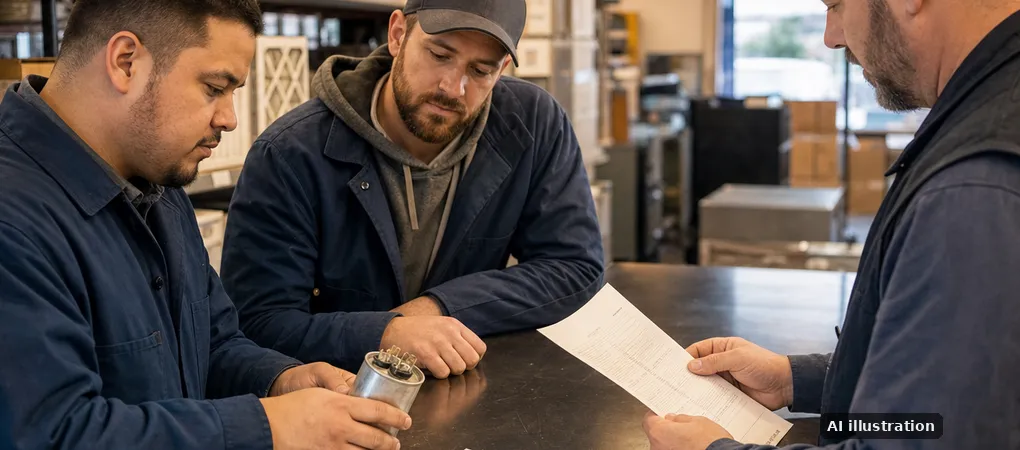
Two minutes after the truck leaves, the quote starts shedding context.
The customer remembers the careful explanation. The technician remembers the strange noise, the tight access, the part that looked tired but not failed. The office sees a short note: “recommend replacement options.”
Goldman Sachs recently highlighted how small business owners are using AI to help propel growth. Good. But in HVAC and skilled trades, AI growth does not begin with a clever prompt in the back office.
It begins with the quote/scope prep note: the small deliverable that decides whether the next person can price the work, explain it cleanly, and get the customer’s approval without reconstructing the visit from memory.
Break down the quote/scope prep note
Take a common anonymized HVAC case: an older split system after a comfort complaint. The technician is not making an AI diagnosis. The human still decides. The record should carry what the human saw, measured, changed, and still does not know.
- Observed: equipment condition, access limits, customer symptoms in their own words, visible wear, safety concerns, prior repair clues.
- Measured: temperatures, pressures, voltage, amperage, static pressure, filter size, model and serial, photos or readings when permitted.
- Changed: settings adjusted, parts replaced, panels opened, drain cleared, filter changed, temporary steps taken.
- Still uncertain: readings that need recheck, parts availability, access requiring approval, comfort complaint not reproduced, customer decision pending.
Sample entry: “Customer says upstairs bedroom ‘never catches up after 4 p.m.’ Observed dirty return grille and restricted filter. Measured supply/return split at 14°F, outdoor unit washed, capacitor within range. Changed filter. Still uncertain: static pressure needs full check before quoting duct modification.”
Pick the last quote that bounced between the field and the office.
Which field was missing: observed, measured, changed, or still-uncertain? That is where your AI workflow actually breaks.
This is also where consent matters. If wearable AI feels like the boss spying on workers, it will fail the culture test before it reaches the workflow test.
Some states have two-party or all-party consent rules. The EEOC’s December 2024 technical assistance on workplace wearables also reminds employers that devices can raise discrimination, disability, and medical-information issues. The right frame is worker-controlled, work-only memory, transparent to the people in the room.
That is the opening for Hearit.ai HA-MIC01: not as surveillance, and not as a replacement for ServiceTitan, Housecall Pro, Jobber, or Dynamics. Those systems own the workflow. The missing piece is the permitted field voice data that lets the workflow reflect what happened on site.
The durable rule is simple: AI can only help the trade as far as the job memory is trusted by the technician.
And the test for any recording tool is strict. The reviewed record must be faster to produce than today’s note. If the technician has to babysit the system, rewrite the output, or defend the context later, the workflow has not improved.
AI is moving from chat answers to operational memory. For field service, the first Physical AI rides with human workers before it rides alone.
If you want to test this, share a de-identified quote note or work order and mark the fields your team struggles to capture. The next advantage in the trades is not louder automation. It is consented job memory people trust enough to use.