
The MCR Test for HVAC AI Agents
AI agents are moving into small business, but HVAC work starts in motion. Use the MCR Test to choose phone, mic, vest, or instruments for field memory.
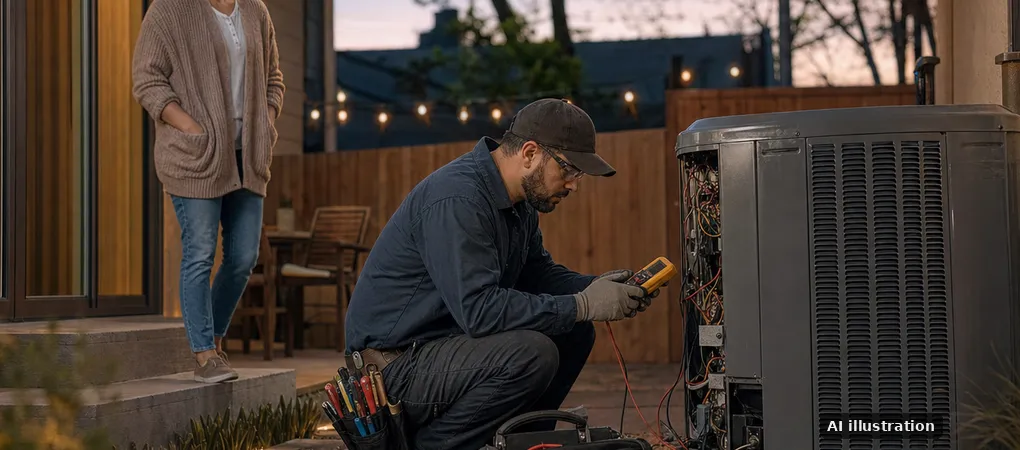
Use the MCR Test — Motion, Cleaning, Review — before you trial another AI agent for HVAC field work. The tension is simple: the back office is being promised agents in 2026, while the technician is still balancing a panel door, a flashlight, a meter, and a homeowner question at the unit.
That gap is the invisible problem. AI can reason over what it receives. But on a service visit, the most useful facts are spoken while hands are occupied, while the system is open, while the customer is explaining the symptom in their own words.
Myth: the small-business AI agent starts in the office
The current wave of small-business AI agent commentary, including the 2026 framing now circulating from Bitcoin Foundation and others, is directionally right: smaller companies will use agents for scheduling, summaries, follow-up, purchasing, and admin work.
But for HVAC, the office agent is not the hard part. The hard part is feeding it the reality of the job without asking the technician to become a clerk after a long day.
- Motion: What does the tool cost the technician while working?
- Cleaning: How much junk, duplication, and job-matching work does it create afterward?
- Review: How hard is it for a human to approve the final work order or service report?
That is the MCR Test. It is not about which device looks most advanced. It is about which input method fits the job without damaging the job.
Proof 1: context is created in motion
A good HVAC work order does not come from one final note. It comes from the sequence: customer symptom, first observation, safety check, reading, decision, explanation, recommendation.
Humans do not store that sequence like a database. They compress it. They remember the conclusion and drop the path, especially when the next job is already waiting.
The technician does not forget because they are careless. They forget because working memory is not a filing system.
Phone in hand
A phone is enough when the job is short, clean, and mostly visual: a filter photo, a model plate, a quick customer approval, a short dictated note before leaving the driveway. For many maintenance visits, this may be the right level of tooling.
What it does not catch well is the live diagnostic narration. The phone asks for a hand, an unlock, a clean glove, and attention that should be on the unit.
- Motion cost: high when gloves, ladders, attic access, rain, or tight mechanical spaces are involved.
- Cleaning cost: photos, notes, and voice snippets often need to be matched back to the right job and field.
- Review cost: low for one or two artifacts, high when the office has to interpret a pile of fragments.
Proof 2: every input tool has a different tax
The wrong comparison is “which tool captures more?” The better comparison is “which tool creates the least tax for this kind of job?”
More data can be worse if it creates more sorting, more consent confusion, or more review burden. The owner does not need a museum of the visit. The owner needs usable memory.
Pick the last callback caused by a vague work order.
What did the technician check at the unit that never reached the record? Now ask which input method would have caught that fact without slowing the repair.
Clip-on or head-worn audio
A clip-on or head-worn audio device can be enough when the technician is willing to narrate: “capacitor tested, contactor inspected, homeowner says noise started after the storm.” It can support a practical voice-to-work-order demo because the spoken path is there.
What it does not know is what was seen unless the technician says it. It also does not know which reading came from which instrument unless the workflow makes that explicit.
- Motion cost: usually lower than a phone, but comfort, placement, cables, and start-stop behavior matter.
- Cleaning cost: moderate; long audio needs job boundaries, speaker context, and removal of irrelevant talk.
- Review cost: manageable if the output is structured into work order fields, not dumped as a transcript.
This is where Hearit.ai HA-MIC01 fits the strategy: not as “recording hardware,” but as the hands-free field ear for the Field Voice Data Layer — turning permitted spoken work into draft service reports, work orders, and searchable Frontline Work Memory for human review.
Wearable AI vest
A vest starts to make sense when the job is physically complex: crawlspace inspection, restoration assessment, multi-room plumbing investigation, or HVAC work where the technician moves between equipment, access points, and customer explanations.
But the vest is not worth it for every shop. If most visits are short, if documentation requirements are light, if the team will not review draft reports, or if the customer setting does not support transparent work-only recording, a vest can be too much tool.
- Motion cost: fit, heat, module placement, and power workflow must be tested in the real movements of the trade.
- Cleaning cost: higher than a simple mic because garments, mounts, optional images, and job association all need operating discipline.
- Review cost: potentially valuable for complex reports, but only if humans still approve the conclusions.
Hearit.ai HA-VEST01 is still in prototype iteration and pilot preparation. It is designed to link permitted on-site voice and optional images to the job so technicians reconstruct less and teams can prepare reports for professional review; the claims that matter still need validation in pilot work.
Proof 3: instruments measure facts, not decisions
Dedicated HVAC instruments are essential. A manometer, meter, scale, combustion analyzer, or gauge set gives a kind of fact that voice cannot invent and should not pretend to replace.
For exact readings, instruments win. Full stop. The danger is thinking the reading alone explains the work.
Dedicated instruments
Dedicated instruments are enough when the problem is a measurement problem: pressure, voltage, temperature split, airflow, refrigerant weight, combustion values. They are the right source of record for calibrated facts.
What they do not carry is the surrounding judgment: why the technician took that reading, what condition they found the unit in, what the homeowner said had changed, and why repair or replacement was explained the way it was.
- Motion cost: normal for the trade, but readings still have to be paired with the job record.
- Cleaning cost: low if the instrument exports cleanly, higher if someone photographs screens or types values later.
- Review cost: low for numbers, higher for the story around the numbers.
The better frame: Physical AI starts as work memory
The useful AI agent for an HVAC shop is not a floating assistant that magically knows the field. It is an agent with access to the spoken record of the visit, the structured readings, the approved photos, and the technician’s reasoning while the work was happening.
SaaS owns the workflow. AI owns more of the reasoning. The missing category is the real-world input layer that turns field facts into memory a machine can search and a human can trust.
For an owner or operations lead, the trial should not start with a device preference. Start with one job type and run the MCR Test.
- If the job is simple: phone notes may be enough.
- If the job is hands-busy but mostly verbal: hands-free voice may be the right first trial.
- If the job is spatial, dirty, and report-heavy: a vest may be worth testing, with consent and review built in.
- If the job depends on exact values: instruments remain the source for measurements.
If you are preparing a pilot, share a de-identified work order or service report and mark the fields your team struggles to fill accurately after the visit. That is where the AI agent conversation becomes real.
The first Physical AI in HVAC will not replace the technician. It will ride with the technician long enough for the work to remember what the visit actually taught.