
Before Drywall, Make the Work Remember
Before drywall hides the work, renovation teams need records tied to place, decision, and consent—without turning documentation into theatre for review.
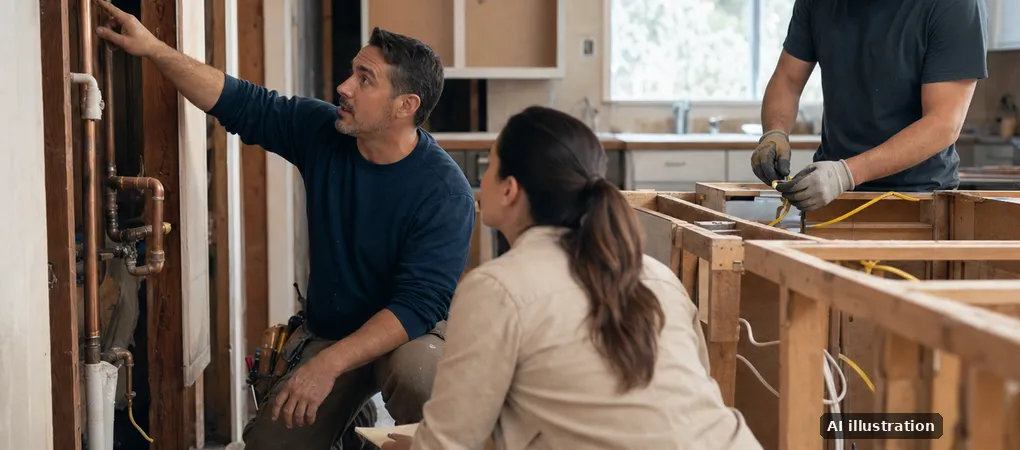
Pre-cover documentation is about to move from photo dump to job memory.
You know the moment. The wall is open, the plumber has moved a line three inches, the electrician has found an old splice that was not on the plan, and the homeowner is asking whether that little change affects the cabinet layout. Everyone nods. Someone takes a few photos. Drywall arrives tomorrow.
Later, the record says: “rough-in complete.” Very economical. Also nearly useless.
The invisible problem in renovation is the closure gap: the difference between the version designed on paper and the version actually shipped inside the wall.
The wall is a memory deadline
Take a typical occupied kitchen remodel. The field-service SaaS or project tool may hold the estimate, schedule, selections, tasks, change orders, and invoice. Good. That is necessary.
But the software still depends on humans typing the field reality in after the fact. And humans are not bad databases because they are lazy. They are bad databases because they are human.
The most valuable renovation record is often made five minutes before the work becomes unseeable.
That is the reasoning behind the Field Voice Data Layer. SaaS owns the office process. AI can help reason over the record. But the job itself still needs a way to preserve what workers observed, explained, checked, changed, and accepted while the studs were open.
Not everything deserves a documentary film. Some records need one photo. Some need a measurement. Some need a spoken explanation tied to a room, a wall, and a person responsible.
What is worth recording before cover?
- Pre-cover conditions: supply lines, drains, shutoffs, vents, wiring paths, blocking, framing repairs, insulation gaps, firestopping, access panels, and anything that will be expensive to rediscover later.
- Change decisions: where the plan changed, who requested it, who approved it, and what trade adjusted the work.
- Handoffs: what the rough-in crew needs the drywall, cabinet, tile, or finish crew to understand before they continue.
- Exceptions: unsafe conditions, hidden damage, owner-supplied materials that changed layout, and work left open for inspection or review.
The unit of memory should not be “the job.” That is too broad. Tie each record to the room, surface, elevation, trade, decision owner, and date.
“Kitchen, sink wall, left of window, plumbing rough-in, moved supply to clear drawer bank, approved by PM” is boring. Boring is excellent. Boring survives turnover.
Four ways to capture the work
For renovation teams, the useful question is not “what device is coolest?” That question should be left in a drawer with dead batteries.
The useful question is: what is enough for this moment, and what does it cost the worker in motion, cleanup, and review?
- Phone in hand: Enough for simple pre-cover photos, quick measurements on visible work, and small crews where the PM reviews the album the same day. It misses the spoken reasoning: why the line moved, who agreed, what concern the homeowner raised. It also costs motion. Gloves come off, the worker frames the shot, unlocks the device, and later someone sorts thirty similar photos with delightful names like IMG_4821.
- Clip-on or head-worn recorder: Enough for walkthrough notes, punch-list narration, and handoffs where the worker needs both hands. It captures more context than a photo, especially trade reasoning. It may miss location unless the speaker says it clearly, and it often creates cleanup work: trimming long audio, separating private conversation, and matching notes back to the right wall.
- Wearable AI vest: Potentially useful when the work has many zones, changing body position, and repeated transitions between crawlspace, room, truck, and customer discussion. The vest is not worth it for a single vanity swap, a two-photo inspection, or a crew that has not agreed on consent rules. Hearit.ai HA-VEST01 is in prototype iteration and pilot preparation; it is designed to explore how permitted on-site voice and optional images can be linked to the job so technicians reconstruct less and teams can prepare reports for professional review. That has to be validated in a pilot, not claimed from a spec sheet.
- Dedicated instruments: Moisture meters, circuit tracers, pressure gauges, laser measures, thermal cameras, and inspection scopes are enough when the question is a measurement or verification. They are often the right authority for the fact. What they miss is the surrounding explanation: why the reading was taken, what surface it refers to, what changed because of it, and who accepted the next step.
Pick the last wall your team closed.
Without opening three apps and a photo folder, can you tell who approved what is inside it, where exactly it is, and what changed from the plan?
Location and responsibility beat more media
The common failure is not that crews lack files. It is that the files float. A photo without location is a souvenir. Audio without responsibility is a rumor with a timestamp.
A good pre-cover record should answer four plain questions.
- Where: property, floor, room, wall or ceiling plane, and reference point.
- What: the condition, measurement, change, or exception being documented.
- Who: recorder, trade involved, reviewer, and decision owner.
- Why now: pre-cover, change order, inspection, handoff, or customer approval moment.
This is where voice matters. A worker can say, while looking at the open wall, “north kitchen wall, sink base, drain shifted to clear drawer box, blocking added for pot filler backing.” That sentence carries structure if the system knows how to attach it to the job.
And yes, someone still reviews it. Professional work does not become professional because software wrote a neat paragraph. Humans decide and diagnose; the record carries context.
Occupied homes need consent, not cleverness
Renovation work often happens around family life. That means documentation rules must be plain enough for a tired crew to follow on a Tuesday afternoon.
Consent-first is not a legal flourish. It is how you keep documentation from becoming surveillance with a hard hat.
- Tell the homeowner what is being recorded: work-only voice, images, or measurements for the job record.
- Mark private zones: bedrooms, bathrooms, desks, children’s areas, medications, valuables, and family photos need extra care or exclusion.
- Give workers control: clear start, pause, and stop behavior. No hidden recording. No guessing.
- Separate review from spying: use the record to clarify work, prepare reports, and support handoffs, not to turn every sentence into a performance review.
- Keep only what belongs to the job: remove unrelated household conversation and avoid storing personal details that do not help the work.
The dignity point matters. Senior tradespeople often carry pattern recognition that is hard to write down and easy to lose. The goal is not to squeeze them into forms. It is to preserve the parts of their judgment the next person will need.
Where the prediction lands
Renovation teams will not win by recording everything. They will win by recording the moments that expire: before cover, at change approval, and during handoff.
The office system will keep owning the schedule and paperwork. The missing layer is the job memory that forms before anyone sits at a keyboard. That is where voice, images, instruments, and human review have to meet.
For the next renovation job, do not boil the ocean. Pick one pre-cover step: the shower valve wall, the kitchen sink wall, the electrical rough-in at the island, or the crawlspace repair before insulation returns.
Document that one step with place, responsibility, consent, and a plain spoken explanation. If the wall closes and the record still knows what happened, you have not just stored media. You have kept the work from disappearing.