
Restoration Proof Needs a Map
Restoration proof breaks when photos lack area, angle, and acceptance. Here's the checklist-first record AI hardware must support on dirty jobsites.
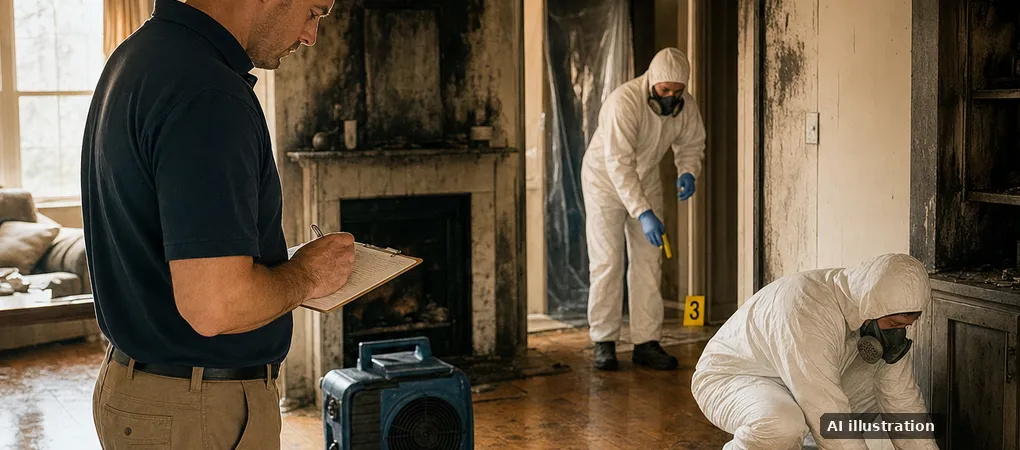
Prediction: restoration proof is moving from photo folders to area acceptance records.
A beautiful after photo and an unseen closet corner should not be able to pass the same review. Yet that is exactly what happens when the job record is a pile of images, a few rushed notes, and someone trying to reconstruct the order of work at the end of a long day.
Field note: photos are not proof by themselves
Restoration work is area-by-area work. Bedroom wall. Hallway ceiling. Cabinet toe-kick. Utility room floor. The proof has to follow the same structure.
Random before and after photos fail for a simple reason: the reviewer cannot compare them. One image is taken from the doorway, the next from the opposite wall. One includes the baseboard, the other crops it out. One room gets six photos, the adjacent closet gets none.
- The image may be real: but not tied to the exact area.
- The work may be good: but the record cannot prove what was completed.
- The report may be long: but the acceptance decision is still unclear.
This is why restoration documentation is about to become more structured. Not because owners want more paperwork. Because AI cannot reason from a messy photo dump any better than a service manager can approve from one.
The repeatable sentence is this: a restoration photo only matters when it belongs to a named area, from a repeatable position, with an acceptance decision.
Field note: the checklist is the spine
The future record is not “more photos.” It is fewer orphaned photos.
A comparable restoration record needs a spine before the device ever turns on. That spine is the area list: room, surface, condition, required action, completion evidence, reviewer note, sign-off status.
- Same location: a kitchen cabinet section should map back to the same cabinet section later.
- Same area language: “north wall bedroom one” beats “wall pic” every time.
- Same review step: someone must be able to say accepted, rejected, or needs professional review.
- Same exception path: blocked access, unsafe entry, customer item not moved, moisture concern, odor concern, or further inspection needed.
AI becomes useful here only after the work record has handles. It needs names for areas. It needs permitted context. It needs the technician’s spoken explanation linked to the part of the job being reviewed.
Pick the last water or fire restoration job that had more than three areas.
Could your service manager compare each before photo to the matching after photo without asking the crew what they meant? If not, the problem is not the camera. It is the absence of an acceptance map.
Field note: a worn device adds its own burden
Restoration jobs are dirty in specific ways. Water work brings humidity and contaminated surfaces. Fire work brings soot that finds seams. Demo dust gets into fabric, ports, hinges, microphones, buttons, and charging contacts.
So the engineering question is not only, “Can a worn device document the job?” The better question is, “Who cleans it, how often, with what chemistry, and what happens when the cleaning step is skipped?”
This is the ODM trade-off product teams should not hand-wave: cleanable sealing versus field serviceability.
Option one is a more sealed, integrated module. Fewer exposed seams. Fewer dirt traps. Easier wipe-down. The cost is higher enclosure discipline, more thermal work, harder repair, and more care around battery access, charging, microphone ports, and any camera window.
- Sealed module cost: more custom tooling, tighter gasket control, harder rework, more validation around cleaning and heat.
- Modular serviceable cost: more connectors, covers, cable routing decisions, assembly steps, and points where grime can collect.
- Protective cover cost: consumables, optical distortion risk, muffled audio risk, and another step the crew must remember.
Option two is a removable electronics module mounted on a garment or vest. That makes garment cleaning and module replacement easier. But connectors become the battlefield. A connector that behaves on a bench can become a complaint source after soot, sweat, insulation fibers, and rushed end-of-day charging.
Option three is a protective accessory strategy: replaceable lens films, port covers, wipeable outer shells, or job-specific covers. This can protect expensive electronics, but it shifts discipline to the crew. If the cover changes the photo or audio quality, the record suffers.
“The right hardware choice depends less on the sensor spec and more on the cleaning ritual the crew will actually follow.”
What changes the answer
For product teams building worn AI hardware for restoration, the answer changes by job type. A crawlspace inspection has different contamination than a smoke-damaged living room. A light cleaning crew has different motion than a mitigation crew carrying equipment through a wet hallway.
It also changes by who owns the record. If the technician must speak the condition, take the image, tag the area, and keep working, the interface has to be simple under gloves and PPE. If the supervisor signs off later, the record must preserve the area trail without relying on memory.
- If the environment is wet: prioritize cleaning procedure, protected charging, and clear limits on exposure.
- If the environment is sooty: reduce crevices, protect optics, and assume black residue will find every gap.
- If crews swap devices: design for fast inspection, clear status, and cleaning accountability.
- If professional review is required: keep the AI record as organized evidence, not a diagnosis engine.
Where HA-VEST01 fits in this direction
Hearit.ai HA-VEST01 is in prototype iteration and pilot preparation, designed to explore how permitted on-site voice and optional images can be linked to the job so technicians reconstruct less and teams can prepare reports for professional review. Garment prototypes and fit photos exist, and the V4.13 structural design covers a two-layer vest, module mounts, cable routing, and split power pockets; full-unit tests and pilot results still need validation.
That distinction matters. The goal is not to turn a vest into a magic restoration report. Humans decide. Humans diagnose. The record should carry the area context cleanly enough that the review is faster, fairer, and less dependent on what someone remembers after the truck is packed.
The trend: AI will punish vague records
Back-office software already owns the workflow. AI is getting better at summarizing, searching, and drafting. The weak point is the field record: the spoken condition, the exact area, the before state, the after state, and the acceptance decision.
Restoration companies that treat documentation as a camera problem will keep getting camera problems. More images. More sorting. More “which wall was this?” moments during review.
- The old record: photos first, explanation later.
- The better record: area first, evidence attached.
- The AI-ready record: area, voice context, optional image, exception, and sign-off bound together.
This is the Field Voice Data Layer showing up in restoration. Not surveillance. Not a cheap recorder. Work-only memory, transparent recording, and technician-controlled context that turns the service visit into something searchable next time.
For restoration companies preparing to test this kind of record, share a de-identified area acceptance checklist: rooms, surfaces, exceptions, photo requirements, and sign-off fields. Mark the fields your crews struggle to collect while the job is still dirty, because that is where the next generation of worn AI hardware has to earn its place.