
AI Growth Has a Memory Problem
Goldman Sachs says small businesses are using AI for growth. The next limit is field memory: what your team knew in the moment but never recorded for reuse.
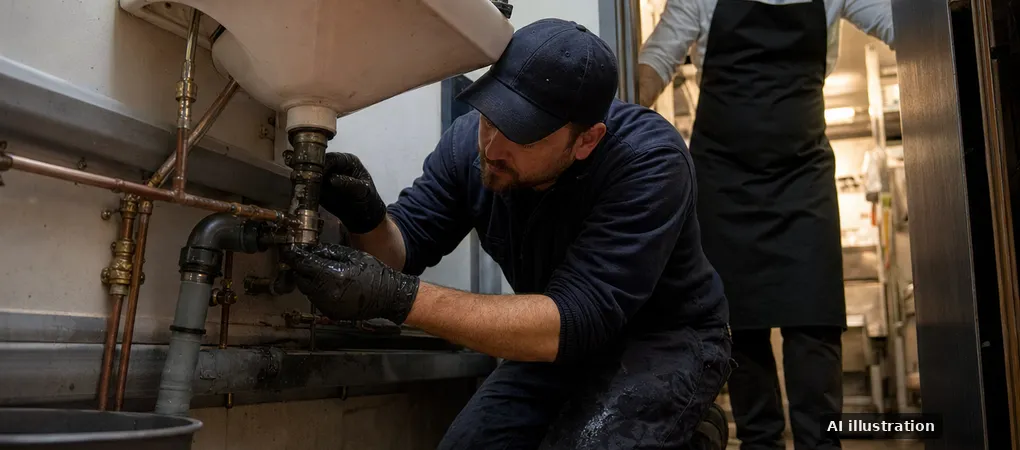
Thirty seconds under a wet sink can decide whether your AI becomes useful or stays a polished office toy.
Goldman Sachs recently highlighted how small business owners are using AI to help propel growth. The common reading is simple: buy more AI tools, move faster, look bigger than your headcount.
That is the myth. For property service operators, the harder truth is that AI growth depends less on the model and more on whether the business remembers the work accurately.
The invisible problem: designed knowledge versus shipped memory
Your workflow was designed to know what happened. The job record that gets shipped back to the office often knows only what someone had time to type.
Illustrative example: a plumber is on one knee in a restaurant restroom vanity. Gloves wet. Supply line stiff. Customer standing at the doorway asking whether the old shutoff should be replaced while the tech is feeling for thread bite and trying not to crack a fitting.
Proof one: the highest-value facts appear when hands are unusable
The tech may say, “The valve turns, but it is not confidence-inspiring,” or “Access is poor; replacing it now may open the wall.” That sentence is not decoration. It explains judgment, risk, and customer consent.
But it often becomes a vague line later: checked shutoff. That gap is where return visits get expensive, not because anyone was careless, but because the physical work defeated the administrative record.
Proof two: AI cannot reason from what the business never owned
Small businesses adopting AI are discovering a basic economic rule: generic tools depreciate as everyone gets them. Proprietary work memory compounds because it belongs to the operator.
The useful asset is not “AI usage.” It is the permitted, searchable memory of what your team observed, explained, declined, approved, and decided at the job.
Pick the last return plumbing customer.
Without checking the system, what did the tech say about the shutoff, access, and customer concern? Now read the work order. The difference is your memory gap.
Proof three: the best input is not always more typing
A hands-free wearable with voice and a body-worn view can help here. It can record the words said in the moment, the visible condition of the valve, the sequence of inspection, and the customer’s permitted acknowledgment.
It cannot feel torque. It cannot see inside a wall. It should not diagnose for the plumber or turn a messy field condition into false certainty.
At Hearit.ai, HA-MIC01 is built around this idea: the Field Voice Data Layer is work-only memory for the physical business, not surveillance and not a replacement for the technician’s judgment.
There are exceptions. If the job is truly routine, the checklist is enough. If one person works while another documents, the gap narrows. If code forms already force complete notation, voice may add little.
But in tight spaces, wet gloves, noisy rooms, and customer questions, the record usually breaks at the same place: the moment the business is learning the most.
“AI growth will not belong to the company with the most prompts. It will belong to the company whose work can remember itself.”
The next test is modest: take one de-identified work order or report and mark the fields your team struggles to reconstruct. That is where AI stops being a trend and starts becoming operating memory.