
The New Clock Starts Before the Truck Rolls
Voice AI in restaurants proves the new service clock: hear fast, structure facts, and make the next worker smart instantly in HVAC.
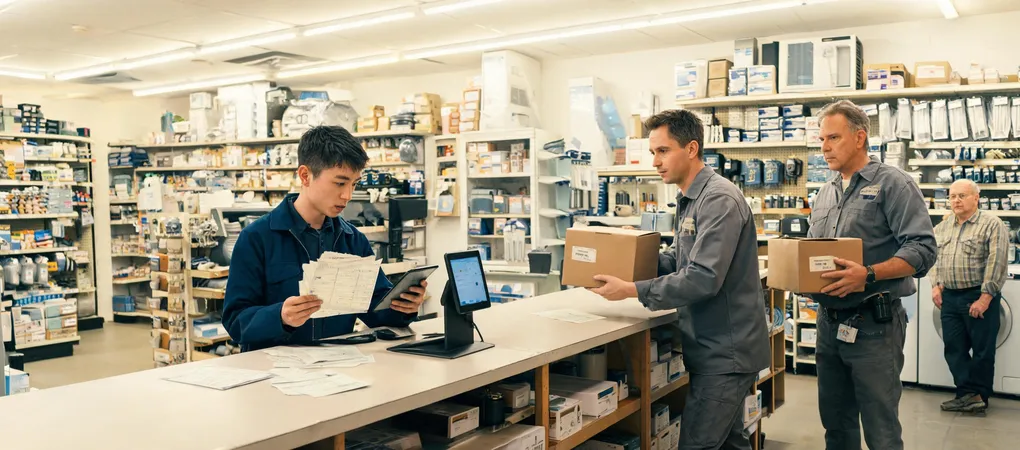
How long does it take your shop to move from “the customer is talking” to “the next person knows exactly what to do”?
That is the clock now. Not someday. Now.
Loman AI and SpotOn just announced voice AI for restaurants inside the POS flow. That matters beyond restaurants because it shows where service work is going: the first system to hear the customer, structure the facts, and route action wins the next step.
In HVAC, plumbing, and electrical, your competitor may not be better than you. But if their AI responds in two seconds and your team reconstructs the situation two hours later after a compressor swap, the customer feels the difference.
The new advantage is not just answering fast. It is making the next worker smart instantly.
There is real data behind this pressure. The Harvard Business Review analysis “The Short Life of Online Sales Leads” found that companies trying contact within one hour were nearly seven times more likely to qualify a prospect than those waiting longer. Lead Response Management research from Dr. James Oldroyd has long shown the same curve: response speed decays brutally after the first few minutes.
But the trades have a harder problem than restaurants. A restaurant order is bounded: menu item, modifiers, pickup time. A no-heat call is messy: attic access, prior repair, tenant description, unit age, weird noise, warranty clue, the part the senior tech remembers from last winter.
Pick the last urgent customer call. How long until your dispatcher, tech, and owner all had the same full context?
Not the ticket title. Not “unit not working.” The actual words, constraints, history, and field facts needed to act cleanly.
This is why we built Hearit.ai around the Field Voice Data Layer. Telalive captures customer phone conversations into searchable customer memory. HA-MIC01 captures spoken work at the jobsite: in the bay, on the roof, in the crawlspace, at the customer’s door.
Not as surveillance. Not as a cheap recorder. As the ear of AI for physical work, controlled transparently around work-only memory.
Here is the engineering truth: reconstruction can get cheaper, but it never becomes original. If the tech says the blower wheel had play, the customer mentioned the upstairs nursery, and the unit tripped only after rain, that signal is highest quality at the moment it is spoken.
Typing later is compression. Memory is compression. A vague work order is compression with damage.
HVAC is the first battlefield because the work is high-context and mobile. The U.S. HVAC market is roughly $159B, with about 120,000 contractors and hundreds of thousands of technicians carrying the real facts in their heads and voices every day.
ServiceTitan, Housecall Pro, Jobber, and Dynamics own workflow. But workflow still depends on humans typing reality after the fact. Hearit.ai is the missing input layer those systems need: the field ear that turns spoken work into service reports, work orders, and Frontline Work Memory.
Restaurants are proving customers will accept AI that hears and acts quickly. Trades will prove something bigger: Physical AI starts by riding with human workers before it ever replaces a hand with a robot arm.
Robots need eyes. Field AI needs ears. And the shop that hears first will manage the next hour better than the shop still asking, “What did they say again?”
From AI phone agents to custom hardware — we’ve got you covered.