
Voice-to-Work-Order Is the AI Growth Test
Goldman Sachs says small firms are using AI for growth. In HVAC, the proof is a faster reviewed work order built from field voice, not another dashboard.
AI growth is now a small-business operations question.
Goldman Sachs recently highlighted small business owners using AI to help propel growth. For HVAC and skilled trades, the useful question is narrower: does AI make the work order better before the next visit depends on it?
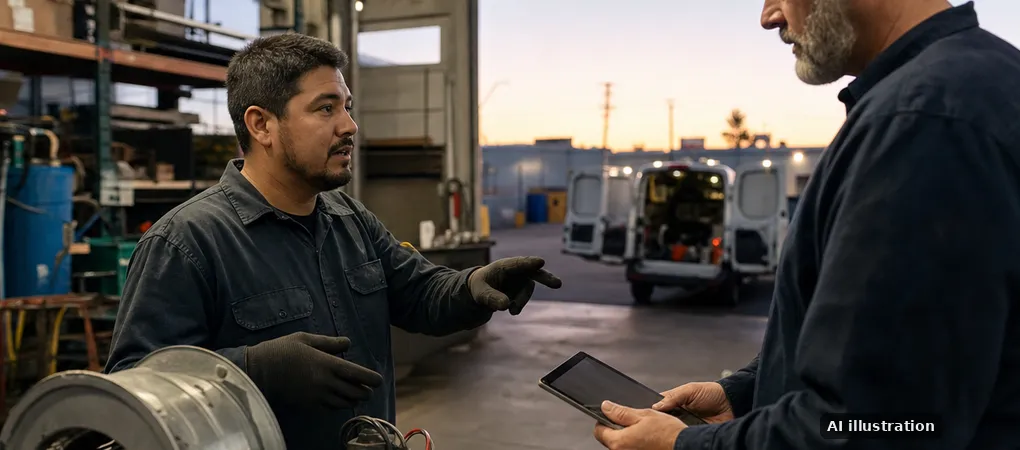
Take an anonymized HVAC shop pattern most managers recognize. A technician diagnoses an intermittent comfort complaint, explains limits to the homeowner, changes a part, notes a borderline reading, and leaves a short note at the end of the day.
The next person sees: “checked unit, replaced capacitor, advised customer.” That sentence is not false. It is just too compressed to carry the job.
Break down the work order
A work order is not a diary. It is a handoff object. The fields that matter are the ones that let the next technician, manager, or customer-facing reviewer reconstruct the job without interrogating memory.
- Observed: symptoms, access conditions, customer’s words, visible wear, noises, smells, ice, water, corrosion, prior repair clues.
- Measured: readings taken, meter used, operating state, before/after values, ambient conditions when relevant.
- Changed: parts replaced, settings adjusted, panels opened, filters changed, drain cleared, customer-approved scope completed.
- Still uncertain: intermittent behavior, deferred tests, conditions not present during visit, risks explained, follow-up recommendation.
That separation is not paperwork preference. It is an engineering specification for memory.
“Reconstruction can get cheaper. It never becomes the original signal.”
This is where voice-to-work-order becomes practical. The technician already says most of this at the unit, at the thermostat, at the truck, and at the customer’s door. The question is whether the work memory can preserve the right facts without making the technician type a novel after dark.
Pick the last return customer. Without checking the system, what did your tech say was uncertain last visit?
Now check the work order. The gap between spoken judgment and written handoff is where AI either helps the shop or decorates the software.
A sample entry, not a fantasy
Sample only: Observed: homeowner reported upstairs warm in late afternoon; outdoor unit running on arrival; condenser coil visibly dirty; no unusual compressor noise. Measured: capacitor tested below nameplate range; return temperature recorded at thermostat during cooling operation. Changed: replaced capacitor with customer approval; rinsed condenser coil; verified system restarted. Still uncertain: late-day load issue may remain; recommended checking airflow and attic insulation if complaint returns.
A reviewed entry like that is useful because it separates fact types. Observed is not measured. Changed is not diagnosed. Still uncertain is not failure; it is professional honesty carried forward.
Hearit.ai HA-MIC01 is designed for this role: the hands-free field ear that turns permitted jobsite voice into structured service reports, work orders, and searchable Frontline Work Memory for professional review.
The test is speed after review
A tool does not pass because it captures audio. It passes only if the reviewed record is faster to produce than today’s note.
That is the durable rule: AI in field service creates value when it reduces reconstruction, not when it adds another screen. SaaS owns the workflow. AI can reason over the work. But the real-world input layer must hear the job while the facts are still fresh.
If an HVAC shop wants to test this seriously, start with one de-identified work order or service report and mark the fields hardest to capture. The future of small-business AI will be written less in presentations and more in the line that tells the next technician what actually happened.