
The Water Stain Report Line Test
A practical framework for capturing a visible stain from field note to report line, with trade-offs across phones, recorders, vests, and instruments on real jobs.
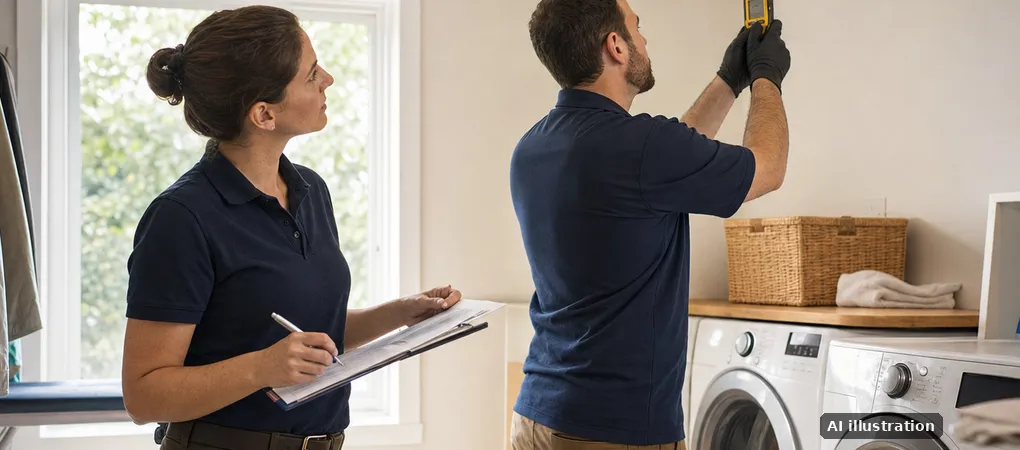
The estimator is back at the office with five ceiling photos and one note: brown stain in hallway. The report writer stops right there: which hallway, which side of the vent, and was moisture actually checked?
Use the Stain Line Four: Place, Seen, Checked, and Boundaries. If a stain cannot survive those four fields, it is not ready to become a report line.
The consensus is wrong: more photos are not the whole answer
The easy answer in restoration, plumbing, and inspection work is to tell the crew to take more pictures. Pictures help. But a stain report is not a scrapbook.
There are three reasons photos alone break down. First, a photo is not a location. Second, a photo rarely carries uncertainty. Third, a photo does not prove what was checked, measured, or explicitly not measured.
- Place: Where is the stain in language another person can use later: room, wall or ceiling, orientation, nearby fixture, access point.
- Seen: What was visible: discoloration, bubbling paint, soft drywall, active dripping, dry staining, staining pattern.
- Checked: What was tested or not tested: moisture meter reading, thermal scan, supply line checked, drain observed, no meter available, area not opened.
- Boundaries: What remains unconfirmed: suspected source, concealed cavity, upstairs fixture not accessed, insulation blocking view, cause not determined on this visit.
A simple case: ceiling stain below an upstairs bath
Take a common residential job: a visible ceiling stain under an upstairs bathroom. The field team sees the stain, talks through possibilities with the homeowner, checks what can be checked, and avoids opening finished material without approval.
A weak report line says: stain noted under bathroom, possible leak. That line forces the office to chase the crew, and it forces the next technician to rebuild the scene from fragments.
“Reconstruction can get cheaper. It still cannot become the original observation.”
A stronger report line says: first-floor hallway ceiling, below upstairs hall bath, stain visible around light fixture and extending toward bath wall. Moisture meter used on stained drywall; reading recorded in job notes. No ceiling cavity opened. Suspected plumbing source unconfirmed; upstairs tub drain area not visually accessed.
Notice the difference. The stronger line does not pretend to diagnose what humans have not verified. It separates observation, measurement, suspicion, and limitation.
Pick the last stain report your office had to clean up.
Which field did the report writer chase: exact location, what was seen, what was checked, suspected cause, or what could not be seen?
Now choose the tool by the field it protects
Do not start with the gadget. Start with the missing field.
Phone in hand
A phone is enough for a clean, well-lit stain where the technician can stop, frame the shot, add a note, and move on. It is cheap because the shop already owns it.
What it misses is motion. The tech sets tools down, unlocks the screen, wipes hands, takes the photo, and later explains what the photo meant. Cleaning time shows up as smudged lenses, wet hands, gloves off, and office review after the job.
Clip-on or head-worn recorder
A small recorder is enough when the main gap is narration: what the tech observed, what was explained to the homeowner, and why the cause remains unconfirmed. It protects the words that usually disappear between the home and the office.
It misses visual reference unless paired with photos. It also creates review work: consent handling, work-only recording rules, noisy audio cleanup, and matching the right words to the right room.
Wearable AI vest
A wearable vest is worth testing when the job is dirty, two-handed, multi-room, or hard to re-enter: crawlspace inspection, restoration documentation, mechanical rooms, or a stain path that runs across several spaces. The value is not the garment. The value is tying permitted voice and optional images to the job while the technician keeps working.
It is not worth it for every stain. If the visit is short, access is easy, the crew already captures the Stain Line Four with a phone, or your report writer needs only one labeled photo and one meter reading, the vest adds handling and review without enough return.
Hearit.ai HA-VEST01 is in prototype iteration and pilot preparation, designed to link permitted on-site voice and optional images to the job so technicians reconstruct less and teams can prepare reports for professional review; that has to be validated in a pilot, not assumed in a sales deck.
Dedicated instruments
Moisture meters, thermal cameras, hygrometers, and inspection scopes are strongest when the report line needs a checked fact. They turn speculation into a bounded statement: measured here, not measured there, access blocked here.
What they miss is context. A meter reading without room, surface, reason, and limitation becomes another orphaned artifact. The motion cost is calibration, probe cleaning, photo labeling, file export, and office matching.
The practical rule
AI can reason over clean inputs, but field work gives it fragments. The missing input layer is the spoken, situated record: what the worker saw, checked, explained, and decided not to claim.
That is the Field Voice Data Layer. In home services, the first Physical AI does not need to arrive as a robot. It rides with the human worker, because the technician is already the sensor with judgment.
For the next pilot discussion, bring one de-identified work order or report with a visible stain line. Mark the fields your report writers chase most: Place, Seen, Checked, or Boundaries. That is where the real trial should start.