
Where AI Agents Should Stop
AI agents should draft the HVAC quote, not own the judgment. The boundary starts with observed, measured, changed and uncertain field facts from the visit.
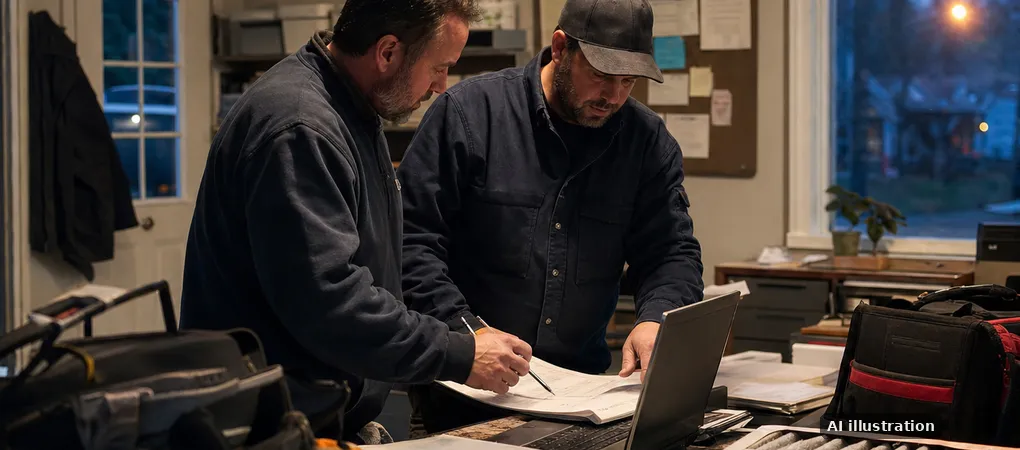
What part of your technician’s work would you trust an AI agent to do after the van leaves the driveway?
That is the real automation boundary for small and medium-sized service businesses. Not “Can AI automate employees?” but “Which part of the work is judgment, and which part is record assembly?”
- The wrong boundary: Ask an agent to decide what happened on a job from a thin note.
- The better boundary: Let the human diagnose, explain and decide. Let AI organize the spoken field facts into a reviewed deliverable.
1. The deliverable to study is the quote scope
For HVAC and skilled trades, the quote scope is where the automation argument becomes concrete. It is the bridge between the service visit and the customer’s approval.
A vague quote creates drag. The office asks the technician what was meant. The customer asks why the work is needed. The next technician arrives with a partial picture.
- Good automation target: Drafting the scope from field voice, measurements and technician notes.
- Bad automation target: Inventing the diagnosis, choosing the repair, or committing the company to work the technician did not approve.
This is where many AI-agent discussions get sloppy. They jump from admin work to judgment work as if the boundary is obvious. In the field, it is not obvious. It has to be designed.
2. An agent can draft only what the job actually captured
ServiceTitan, Housecall Pro, Jobber and similar systems own the workflow. They do not automatically know what was said beside the unit, what the homeowner emphasized, or which part the technician decided not to touch today.
That information is often spoken once, under time pressure, then rebuilt later from memory. The economic problem is simple: the most valuable asset is the one nobody owns yet in a usable form.
The automation boundary is not where the software becomes confident. It is where the field record becomes reviewable.
This is why AI agents need a real-world input layer. Cameras gave AI eyes in many environments. But field service also needs permitted, work-only listening that can capture what the technician observes, explains and decides while the work is happening.
3. Break down the quote scope into four field categories
A quote scope should not read like a sales paragraph first. It should read like a field record first. The customer can feel the difference.
The useful structure separates what was observed, what was measured, what was changed and what remains uncertain. Each category carries a different level of confidence.
- Observed: What the technician saw, heard, smelled, touched, or heard from the customer in their own words.
- Measured: Readings, model details, temperatures, pressures, electrical values, age, serial information, access constraints.
- Changed: Adjustments, replaced parts, cleaning, reset steps, temporary fixes, settings changed during the visit.
- Still uncertain: Conditions that require approval, return access, additional testing, parts confirmation, or supervisor review.
Sample entry: HVAC quote scope
Sample only: Customer reports upstairs bedrooms are warm in the late afternoon. Technician observed weak airflow at two second-floor registers and visible dust buildup at return grille. Measured temperature split was below expected range during cooling cycle. Filter was replaced and thermostat schedule was corrected during visit. Still uncertain: duct condition above finished ceiling was not accessible; quote should include approved return visit for airflow testing and duct inspection before recommending larger equipment changes.
Notice what the agent should not do here. It should not decide the system needs replacement. It should not turn uncertainty into confidence because the quote looks cleaner that way.
Pick the last quote that bounced back from the customer or office.
Was the friction caused by price, or by missing context: what was checked, what changed, and what the technician was still unsure about?
4. The right delegation is drafting, not deciding
The prevailing AI-agent pitch is often too broad: delegate more, faster. In skilled trades, that creates a quiet risk. The agent may produce a clean document that hides a messy field reality.
A better delegation map is tighter.
- Delegate extraction: Pull key facts from permitted field voice and job context.
- Delegate organization: Sort the facts into observed, measured, changed and still-uncertain.
- Delegate drafting: Prepare a quote scope or work-order note for review.
- Keep with humans: Diagnosis, customer commitments, safety judgment, code interpretation and final approval.
This is not anti-automation. It is pro-boundary. The first Physical AI in home services will ride with human workers before it shows up as a robot; the technician becomes the sensor, and the AI becomes useful because it receives better reality.
5. The field ear matters more than another back-office agent
If the only input is a rushed end-of-day note, the agent is working from depreciation. Memory fades. Customer wording blurs. The technician may remember the big decision but not the small condition that explains it.
That is the category Hearit.ai HA-MIC01 is built around: not as recording hardware, but as the hands-free field ear for the Field Voice Data Layer. It is designed to capture permitted work voice at the moment of service and turn it into reviewed reports, work orders and searchable Frontline Work Memory.
- Consent-first: Transparent, work-only recording with technician dignity.
- Human-reviewed: AI drafts the record; professionals approve what goes out.
- System-friendly: The record can support the workflow tools a shop already uses rather than replace them.
Look, anybody can make an agent sound polished in a demo. The hard part is getting the attic, the roof, the mechanical room and the customer explanation into the record without making the technician do paperwork twice.
6. The pass-fail test is speed after review
A recording tool must pass one practical test: the reviewed record is faster to produce than today’s note. If the technician, dispatcher, manager, or comfort advisor spends more total time fixing the AI’s output than they spend writing the old note, the workflow has not improved.
The goal is not a magical fully automatic quote. The goal is a better first draft anchored in what actually happened, with uncertainty preserved instead of washed away.
- Fast enough: Less reconstruction after the job.
- Clear enough: The next person can understand the decision path.
- Honest enough: Unknowns remain visible.
- Useful enough: The same field memory helps the next visit, not just today’s paperwork.
A serious pilot can start with one de-identified work order or quote scope. Mark the fields your team struggles to capture: observed, measured, changed, or still-uncertain.
The small-business AI question is not how much employee work to automate. It is which human judgment deserves a better memory.