
Before You Build the App: What a White-Label Meeting Recorder Pilot Should Prove
Software teams adding a meeting recorder often lead with 32 GB, 20 hours and their own app. Here is how we'd reorder that spec sheet so the pilot proves what matters: capture and delivery.
The longest spec sheet we receive is rarely from a hardware company. It comes from software teams.
A team that has spent two years on a meeting-notes product decides it’s time for its own device. The request that follows is thorough, and it usually looks like this: a Bluetooth and Wi-Fi recorder, at least 32 GB of storage, 20 hours of recording, encryption on the device, our own Flutter app, our own speech backend, no vendor cloud, and a pilot of 25 to 100 units before anyone commits to tooling.
Every line on that list is reasonable. But the list mixes two kinds of requirements: the ones that decide whether the pilot succeeds, and the ones that matter once it has.
Most of the programmes we work on are under NDA, which is why you won’t find customer names on this site. What follows is a composite of the requests we see most often, and how we’d read them.
1. Storage is an upload question, not a capacity question
“32 GB” sounds like a hardware requirement. It is really a statement about how often the device can reach the network.
If the recorder holds audio until someone docks it or opens an app, storage has to cover every hour between syncs. That’s when 32 GB starts to make sense.
If the recorder uploads over Wi-Fi on its own as recordings are finished, local storage becomes a buffer. The question changes from “how many hours can it hold?” to “how long might it be offline?” A device that keeps recording when the network drops, holds on to un-uploaded files, retries on a schedule and reclaims already-delivered files before touching anything not yet sent, needs far less flash than a device that waits for a person to sync it.
Size storage by the longest gap without a network, not by the longest meeting.
Ask the vendor what happens on the day the Wi-Fi is down: does recording continue, which files are kept, and in what order does space get reclaimed?
2. “Up to X hours” is not a runtime
Battery claims are the easiest line on a datasheet to write and the hardest to rely on.
Runtime depends on the codec and bitrate, how often the radio wakes to upload, the microphone configuration and the battery itself. Two devices with the same battery can differ by a factor of two in real use.
For a pilot, ask for measured runtime at the battery, with your settings: your bitrate, your segment length, your upload pattern. If the vendor can’t measure it on a sample before you order a pilot batch, that tells you something.
3. You may not need to build the app first
This is the requirement we question most often, because it is usually the most expensive one.
A meeting-notes product delivers one thing: notes. The device is how the audio gets in. The app is one way to move it, and for many teams it isn’t the fastest way to prove the product.
There are three common architectures:
- Bluetooth to your app. The phone does the work: pairing, recording control, file sync. You need an SDK and an app on two platforms before the first user can try anything.
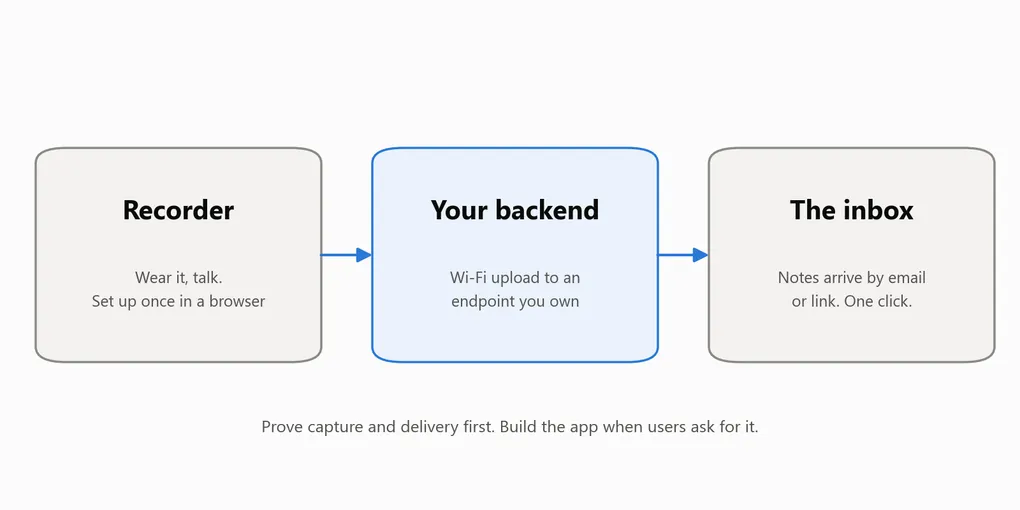
- Wi-Fi straight to your backend. The device uploads finished recordings directly to an endpoint you own. Setup is a one-time step that can run in a browser over Web Bluetooth. Your backend transcribes and summarises, then sends the result where people already work: an email, a link, a message in the tool the team already uses.
- Both. Wi-Fi for bulk delivery, Bluetooth for live control or a companion app later.
For a pilot, the second pattern is often the shortest path. The user’s whole interaction is: wear it, talk, open the email. One click on a link takes them to the notes. Your team spends its first month on transcription quality and summaries, which is what users judge, instead of on Bluetooth reconnection bugs across phone models.
The app can come later, when you know which features people actually use.
4. “Your own backend” has to mean every connection
Teams that ask for “our own backend, no vendor cloud” usually mean the audio. Check the rest too.
A device can upload audio to your endpoint and still phone home for status, updates or activation. Ask for a list of every host the firmware contacts, what each one carries, and which ones can be switched off or pointed at your servers in your build. On our platforms, the audio endpoint, the status channel and the update server are all set per customer build, and the ones you don’t want can be removed.
5. Ask which security features exist today, in writing
Security questions are where spec sheets blur the most. “Encrypted firmware”, “secure boot”, “encrypted recordings” and “signed updates” are four different things, and a device can have one without the others.
Ask the vendor to answer each separately, and to mark each one available today or needs engineering:
- Are firmware updates signed, and who holds the signing key?
- Are recordings encrypted on the device, and with whose key?
- Does the upload require authentication, or just a device ID?
- Is there secure boot?
- Can you hold your own keys?
We give this answer in writing, per configuration, before a pilot is quoted. A vendor that answers with a single word, “secure”, hasn’t answered.
6. A pilot should prove capture, not just hardware
Twenty-five to a hundred units is the right size for a first pilot, and it’s worth being specific about what it should prove:
- Capture rate: of the meetings people meant to record, how many arrived complete?
- Transfer failures: how many files needed a retry, and did any get lost?
- Time to notes: from the end of the meeting to the email in the inbox.
- Pickup: does the far end of the table transcribe as well as the near end?
None of those depends on 32 GB or a polished app. All of them depend on the path from the microphone to your backend.
Small pilot runs on existing platforms are something we evaluate case by case. Custom hardware comes after the pilot tells you what to change.
What we’d do with that spec sheet
We’d keep every requirement on the list, and reorder it:
- Prove capture and delivery with existing hardware, uploading straight to your backend.
- Measure runtime and storage needs from real pilot data.
- Decide which security features the market requires, and engineer those.
- Build the app if users ask for it, and the custom hardware once you know what the pilot showed.
GMIC designs and manufactures voice-capture devices for software companies, from existing platforms through full ODM, with engineering and production in Shenzhen and a commercial team in California.
If you are putting a device behind a meeting-notes or transcription product, send us your spec sheet. We’ll tell you which lines our existing platforms meet today, which need engineering, and what a pilot should measure: [email protected] or book a 30-minute call.
The device is how the audio gets in. The product is what arrives in the inbox.