
Write the Part You Could Not See
A practical guide to writing inspection limits: what was seen, measured, changed, and still uncertain—and why AI field records must respect them.
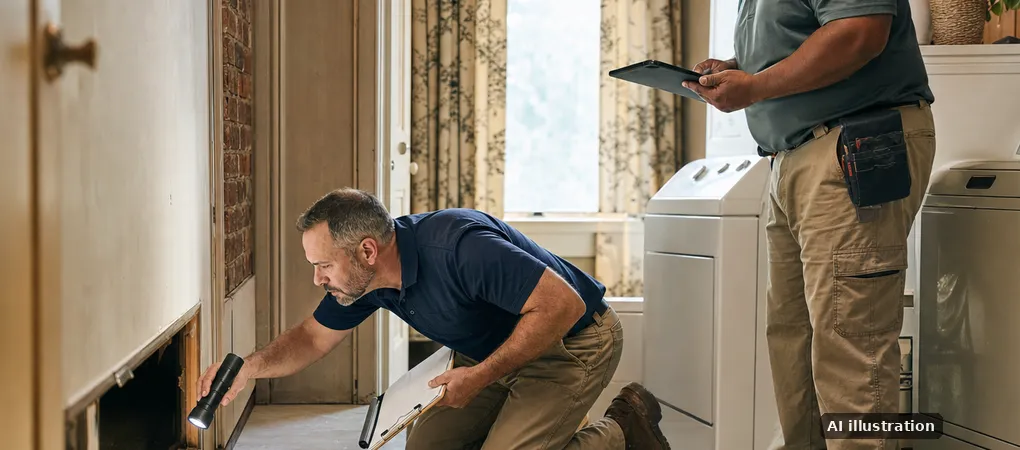
What should your report say when the most important fact is that the space could not be seen?
That is not a legal afterthought. It is a field fact. In home inspection, crawlspace, restoration, HVAC, plumbing, and electrical work, “not observed” can decide whether the next visit is prepared, whether the customer understands the limit, and whether the office has to reconstruct the job from memory.
The limitation is part of the finding
A mature inspection report does more than list defects. It states the boundary of the inspection: blocked access, unsafe entry, stored items, sealed panels, wet conditions, utilities off, areas not tested.
The customer may remember the visible stain. The service manager needs to know the attic hatch was painted shut, the crawlspace entry was too small, or the panel could not be opened without damaging finish work.
Deliverable breakdown: the limitation note
One small section decides whether the report reads as professional or vague: the limitation note.
- Observed: What was visible at the time: blocked hatch, standing water, insulation covering framing, stored boxes in front of equipment.
- Measured: Any objective detail worth preserving: approximate clearance, temperature reading, moisture reading, access opening size, equipment status.
- Changed: What the inspector or technician did: moved no personal items, tested accessible outlets only, photographed the blocked area, explained the limit to the customer.
- Still uncertain: What remains unknown because of the limit: concealed framing condition, hidden moisture path, inaccessible duct section, unverified shutoff or valve.
Pick the last report with an inaccessible area.
Can the next technician tell why it was inaccessible, what was checked anyway, and what remains unverified?
Sample entry
Sample only: Crawlspace was not entered. Access opening was partially blocked by stored materials, and visible soil near the entry appeared wet. Inspector viewed accessible area from the opening, took photos, and explained that framing, plumbing lines, ductwork, and moisture conditions beyond the opening were not fully observed. Further evaluation is recommended after access is cleared.
Why “not observed” must be captured as it happens
A limitation written at the truck after a long day is already a reconstruction. Some reconstruction will always be necessary. But reconstruction gets cheaper only when the original field context was preserved.
The engineering point is simple: the schema beats the model. If the record has no place for “visible,” “tested,” “not tested,” and “why,” AI will fill the silence with polished uncertainty.
This is where Physical AI in property services should start. Not with machines pretending to diagnose houses. With better work memory around what a trained human observed, explained, and decided.
HA-VEST01 is in prototype iteration and pilot preparation, designed to link permitted on-site voice and optional images to the job so technicians reconstruct less and teams can prepare reports for professional review. That idea still has to be validated in a pilot.
The net-gain test
Inspectors already have mature report tools. Any new capture method has to respect that. The reviewed record must be faster to produce than today’s note, or the workflow has not improved.
The standard is not “more media.” It is a clearer professional report with less end-of-day memory work.
If you write or review inspection reports, share a de-identified limitation note and mark the wording that is hardest to capture in the field. The future field record should make the unseen explicit, not pretend it was seen.